


It’s been a while since I last wrote. July feels like it came and went like a dream. It’s mostly our own fault; we traveled for nearly all of July. One week was spent at Pittsburgh Theological Seminary, where we taught in the SYI program. We returned home for six days before a stopover to visit friends and a class at the Farminary of Princeton Theological Seminary, and then a week in western Vermont for wedding and vacation. We arrived home exhausted but grateful for time away and a reprieve from the heat of late summer.
It’s unusual to be gone from the farm for so long. A day or two away, and I’ll start wondering and worrying about animals, newly planted trees or perennials, or projects I left unfinished. A week away and I’ll begin to feel some sense of calm. But then the doubts and wondering crash in all of a sudden, catching me unawares. I’ll pick up the phone and text the farmhand just to make sure nothing terrible has happened (it hasn’t).
Since before we left, our family has been waiting eagerly for our dairy cow to ‘freshen,’ as farmers say, or come into milk. (Allow me to say briefly that cows do not have milk until they calve. Some folks are not aware of this, but they—the cows, but also the folks—are just like other mammals. Milk arrives when babies are born.) Our family cow, Primrose, comes from a venerable line of grassfed Jerseys that live in the foothills of western Maryland. She’s young, and she’s only had one calf before, so we were a little apprehensive about how her second pregnancy would go. Also, younger cows tend to show signs of calving much earlier than older cows, and so we spent one or two nerve-wracked weeks observing signs of birth and wondering if all was as it should have been.
A few days after we got back from Vermont, I rose early to go to market and came back around 1pm. After a quick nap, I got up and checked on the cow. She was tucked away in a corner of hardwoods at the top of the hill behind our house, standing still and silent. A purple tangle of afterbirth trailed away from her. Nestled at the foot of an old oak tree lay a little calf, glistening in the shadows. It looked a bit shell shocked. I ran down to the barn to fetch the rest of the family. By the time we returned, Primrose had birthed a second calf. But twins were not meant to be: as we watched, we quickly realized the second calf was stillborn.
Twins are not good for cows. In some conventional dairies, if a cow is palpated and twins are found, they will terminate the pregnancy. If it’s a male and female calf, the testosterone from the male will interfere with the development of sexual organs of the female (they share a placenta). 90% of the time this results in what farmers call a freemartin, or a sterile female. In any case, the survival rate for both twins is very low, and the milk load on the mother is more than she can bear.
We’re not glad this happened, but we do feel some sense of relief. Two weeks in and the mother and calf are thriving.
***
Humans have been milking domesticated animals since the Neolithic age. It’s one of the most ancient practices of agriculture, and many of the oldest cultures on the earth still depend on it for their survival. It’s difficult sometimes to comprehend this, but tens of millions of people still migrate seasonally or yearly in order to feed themselves from the animal herds that they tend. These migrations typically take two different forms: pastoral nomadism, the irregular wandering of people and animals in search of forage and water, and transhumance, the seasonal migration of livestock and the people who tend them to other pastures. These migrations are sometimes dictated by elevation, rainfall, and fluctuating temperature. In any case, animals and their herders are seeking better forage as the weather changes throughout the year. Many of these migrations revolve around the production of milk and cheese.
If the earliest states relied upon the widespread cultivation of cereal grains like wheat for their survival—and therefore needed coerced labor to make the cultivation of cereals possible in the first place—nomadism and transhumance represent something like the state’s anthropological obverse. How do you hoard and tax food when it’s constantly on the move? And how can you expect to coerce people as long as they are sustained by animals that they follow around, or must move around seasonally, to follow the growth of forages? Movement and migration means occupying, if only temporarily, places that are difficult to access and control. Even the etymology of transhumance seems to challenge the territoriality of the state and the policing of borders. Transhumance literally means moving across the earth or soil (trans + humus). Crossing the soil, moving ruminant animals from one region to the next, requires open access across the land. Concepts like sovereignty and private ownership make little sense to communities that are defined by seasonal migration, shared ritual and custom, and economic cooperation.
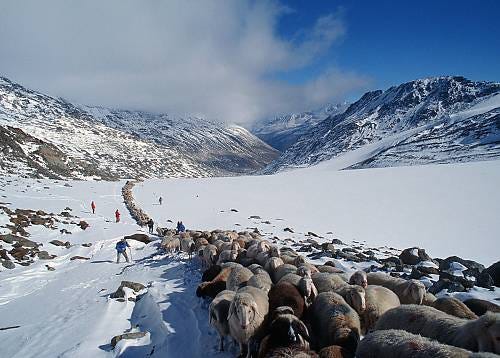
Alpine Transhumance. (photo from here)
James Rebanks’s memoir, The Shepherd’s Life: Modern Dispatches from an Ancient Landscape (2015), contains a lovely description of transhumance and the cooperative social relations that it fosters. The book opens at the end of the summer grazing season in the Lake District of England. Since the beginning of summer, his sheep have been grazing away on the fells, or mountains, where they live untended and unsupervised with other sheep that belong to Rebanks’ fellow shepherds. Rebanks’s people say that the sheep are ‘hefted,’ which means that they know their place in the fells and therefore do not require fencing in the summertime to keep them contained. The mothers teach the lambs where to go and where not to go. The sheep know the fells, and they learn not to wander. The fells lands are held in common, and so the shepherds must work together to manage the landscape and ensure that no pasture is ruined or overgrazed.
The weather on the fells is rough in the winter. Every fall, the shepherds gather together one morning and strike off into the hills with their sheepdogs to fetch their sheep and bring them back to the valley for winter and spring. It’s a sweaty, curse-spluttered affair, with farmers and sheepdogs working together across a wide, steep, and difficult terrain, but Rebanks’s account of it is at times breathtaking, as in this moment when the work is nearly done and the shepherds notice some sheep where they shouldn’t be:
As we head across the fell we see some ewes that should be on our common beyond a deep gill (ravine) on the mountainside opposite. I fear they are too far away to get them today. They will, I assume, come in with the neighboring common and we will collect them later. But Joe, who is cleaning out that gill, has sent his dogs to get them. From where he is, he can scarcely see the sheep as they are so far away. He is farther away than we are. I don’t think it is possible. The dog lurches back, onwards, up and up, climbing higher and higher towards the distant skyline. A whistle or two reassures it that it should keep going for sheep it cannot see yet because the of the lie of the land. Then the dog sees the sheep it has been sent for, and knows what to do. It circles behind them and pushes them out of the crags. They twist and turn ever downwards and back towards us, then disappear down the far side of the gill. Ten minutes after the dogs were sent for the, the sheep rise out of the gill close to our feet. They are beaten and they know it. They trot obediently across the moorland and join the flow of sheep heading home. (28)
Rebanks says that the transhumance of sheep in this region has taken place for as long as anyone can remember. According to genetic testing, the breed of sheep they raise, Herdwick, is more closely related to breeds that are found in Scandinavia than any others in England or Scotland. (It seems likely that Herdwicks were brought over by Vikings in the early Middle Ages.) The pastoralism of the Lake District gave rise to a very specific regional identity among its people, too. William Wordsworth (1770-1850), the English Romantic poet, noted frequently the uniqueness of the Lake District farmers and shepherds with whom he lived and associated. “In the midst of a powerful Empire,” Wordsworth wrote in his Guide Through the District of the Lakes in the North of England (1835), there flourishes a “perfect republic of Shepherds and Agriculturalists.” What enabled this “perfect republic” to flourish was its remoteness from centers of finance, capital, and the all-seeing eye of the state; here was a mountainous region not easily accessible from cities like London or Manchester. Neither “high-born nobleman, knight, nor esquire” could be found among their ranks. It looked therefore to Wordsworth like an “ideal society or an organized community, whose constitution had been imposed and regulated by the mountains which protected it” “Consciousness of the land” bound this people to its place and to one other (58). And this consciousness was shaped through specific acts of love and care for livestock and the land on which the community depended. As Wordsworth explains in a poem called “Michael: A Pastoral Poem,” the last poem in Lyrical Ballads, published anonymously by Wordsworth and Coleridge in 1798:
[...] Grossly that man errs, who should suppose
That the green valleys, and the streams and rocks,
Were things indifferent to the Shepherd's thoughts.
Fields, where with cheerful spirits he had breathed
The common air; hills, which with vigorous step
He had so often climbed; which had impressed
So many incidents upon his mind
Of hardship, skill or courage, joy or fear;
Which, like a book, preserved the memory
Of the dumb animals, whom he had saved,
Had fed or sheltered, linking to such acts
The certainty of honourable gain;
Those fields, those hills--what could they less? had laid
Strong hold on his affections, were to him
A pleasurable feeling of blind love,
The pleasure which there is in life itself. (“Michael: A Pastoral Poem,” 62-77)
It’s difficult to overstate how different the sociality of farming in our region of the United States is compared to what Rebanks or Wordsworth describes, or compared to any other farming community that depends on the seasonal migration of animals for its survival. One difference is topographic. Although on our farm we choose to rotate our ruminant animals intensively, we don’t have the type of elevation that forces us to seek out better forage at different times of the year. Depending on the season we’re in, the grass is more or less in the same condition as it is everywhere else on our farms. But a bigger difference stems from the history of land use in this country, which in the last two hundred and fifty years has been dominated by the concept of private property.
I feel this keenly in my own life. My sense of place is bound quite narrowly to the fifty or so acres that we bought four years ago. I’d like to think that this has allowed me to grow familiar with the nuances of our farm: the different ecologies it contains (prairie, woodland, wetland), the topography, the various soil profiles. There is of course plenty more to learn. But I have to admit that on the other side of the fence, my sense of the land has no foothold. What shape does it take beyond my pastures? How are its horizons composed? What little enclaves of wildness amidst the field crops and pasture land does it contain? This realization startles me from time to time, because I’ve been on my neighbors’ land more than once. When an animal gets out of the fence, I have to walk across someone else’s place to get them and bring them back. Neighbors are typically quite gracious about such events (they are rare). But my knowledge of the land stops rather abruptly at the four borders of my farm. Like most people around me, I am an interloper who has only recently called this region home. The asphalt roads that spread out for miles in every direction feel more familiar than the neighbor’s field that lies three hundred feet away from my back door.
I’m not saying this is inherently wrong, although I do yearn to know the landscape beyond my farm better, as well as the peoples who have inhabited it over the millenia. And I have no present interest in becoming a pastoral nomad. But I am left wondering what forms of communal identity are possible in places like mine, where there is virtually no cooperation left between farmers, landowners, and the people who consume the goods we produce, where farms and woodlands have been broken up, bought, sold, and passed down for generations to the point where a deed map looks like so many bits of broken glass that someone has tried to put back together. With the accelerated growth of suburbs creeping in along the major county and state roads, it seems likely that a terrestrial amnesia will settle in upon all of us, as has happened in countless communities up and down the Eastern seaboard.
What happens to a place, a region, when an attentive love of a landscape—what Wordsworth calls a “consciousness of the land”— is no longer possible?
For Wordsworth, the consciousness of land that he encountered in the Lake District was tied directly to the political freedoms that the people of the Lake District enjoyed in virtue of their remoteness. It therefore seems appropriate to ask if it has ever been possible to maintain a consciousness of the land in this corner of the Carolina Piedmont, where the ghosts of chattel slaves and indigenous people haunt every bend in the road. I’ll take this question up in another essay, but for now I’ll mention that nowadays the only thing that binds farmers together is the fact that we each have absolute claims of ownership over a particular piece of land, and that those pieces of land just so happen to be in close proximity. The Lockean logic that follows from these facts is uninspiring, frankly: we each have a stake in protecting our private property; therefore it is in our mutual interest to work together to protect it and the communities we’ve built upon them. As rural places like mine continue to fight problems they do not have the resources to manage–a devastating opioid crisis, a fractured agricultural economy, a warming climate–it is more urgent than ever to find ways to build coalitions between those who farm and those who do not, between those who own real property like land, farms, and homes and those who do not. It’s not obvious to me yet how we are to go about this work.
***
In the early months of COVID we kept a milk cow named Sugar, a small Jersey cow that belonged to a friend of mine. When we bought her, she had never been milked before, and I had never milked a cow. It took the two of us about six weeks of working together to develop a routine that she would tolerate. I would present the feed to her, she would sniff; I’d dump the feed into her trough, and she’d step forward tentatively into the headgate, and once the headgate locked, I’d commence milking. This went on for about a year. By the time that I went back to commuting to Wake Forest, she had begun to have some health problems, and so we decided to sell her.
Here we are two years later: I am no longer commuting to Wake Forest, and we have a new cow we’ve been milking for two weeks. There’s been a learning curve for Primrose, since she’s never been hand milked and only had one calf before, but I’m delighted at how quickly the memory of milking has come back to me. The technique is fairly simple, once you get the hang of it: wrap your hands around each teat (cows have four, and you usually start with the back ones); punch up slightly with one hand and squeeze as you pull down, then do the other hand and repeat the movements in rapid succession. To get a decent quantity of milk, you have to perform these movements literally hundreds of times with each hand (if not thousands; I’ve never counted) in a single sitting. Pulling off this feat requires a surprising amount of hand and forearm strength; I know someone who has seriously injured their arm doing this. You can’t build this strength up overnight, so it takes the discipline of working at least each morning if not evening, with the proper technique, to get strong enough to milk a cow.
I like to think that our little dairy practice is its own kind of religio, in the older sense of the word: a re-binding, a tying down again. It’s iterative (we do it every day); it requires at least one human to be around the farm each morning and do the necessary work; and though it feeds us, we get no monetary gain from doing any of it (although the milk, yogurt, and cheese we get are unbelievably delicious). But there’s also a way in which milking requires a larger, more encompassing re-binding between our family, the animals that sustain us, and the land that we care for. It’s impossible not to feel reverence for, and kinship with, Primrose and her calf. Their bond nourishes our family, and so I share in her delight when I get to move her to fresh pasture every few days or so. I see her joy as she skips and shakes her head, and I can’t help but feel a little bit of that in myself, too.
Every so often when I’m milking, I feel as though I am trapped in an atavism of my own design. Other days I feel a dim awareness that I’m rehearsing one of the ancient, primordial hacks that’s enabled my species to survive in desperate climes. But most of the time, I’m grateful to milk in the quiet and the stillness of the morning. I get to watch the world around me wake up. Eventually, as I’m finishing up the job, my kids will tumble out the door and watch and help as they are able. Then, when we’re done, we’ll put the cow back in her pasture and get on with the morning.
An addendum, since many of you asked: our twin heifer calf, Peresephone (named by H), was not born with a male twin, and is not therefore a freemartin.