


A few months ago, Plough Quarterly asked me to review two new books on homelessness: There Is No Place For Us, by Brian Goldstone, and Seeking Shelter, by Jeff Hobbs. Goldstone’s book takes place in Atlanta, a city I know fairly well. The other is set in Los Angeles. The review is now online, and you can read it here.
Here are a few points I didn’t have the space to address in the review.
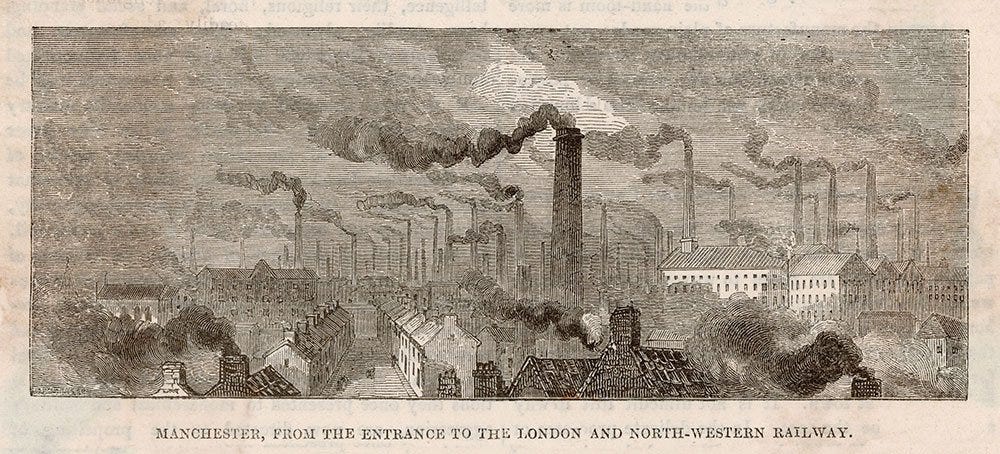
(1) Urban housing markets have feasted on the poor for a very long time—perhaps for as long as the industrial cities have been in existence. In 1842, when Friedrich Engels (of Communist Manifesto fame) moved to Manchester, England to help manage his father’s cotton mill, he spent his off-hours documenting the ways that urban landlords systematically hid from view the poorest of the working class, all while reaping huge profits from unsafe dwellings. In some districts, the city’s poorest residents, usually Irish immigrants, were crammed into shelters beside hogs destined for the slaughterhouse. He wrote: “the industrial epoch alone enables the owners of these cattlesheds to rent them for high prices to human beings, to plunder the poverty of the workers, to undermine the health of thousands, in order that they alone, the owners, may grow rich” (Conditions of the Working Class, 66). Since the 1840s, cities have gotten smarter about sanitation and preventing cholera outbreaks. But the structural problems around housing the urban poor remain as entrenched as they were for capitalist societies of the mid-nineteenth century. The sociologist Matthew Desmond sums up the matter rather dryly in his bestselling study of Milwaukee’s unhoused: “there [is] a business model at the bottom of every market” (Evicted, 61).
(2) Goldstone suggests that there are currently four million chronically homeless families in the US. Another 12 million are severely cost burdened and at imminent risk of being unhoused. What often gets lost in these figures is just how many of the unhoused are children. No one knows for sure, but every number I’ve seen is staggering. For example, just before Hobbs’s book was published (February 2025), officials in LA suggested that there are approximately 64,000 homeless children in the city of Los Angeles alone. 64,000. Let that sink in.
(3) Reductive explanations of what causes homelessness—drug addiction, alcohol addiction, mental illness—these are almost always distortions of the truth and characterize a small fraction of those who are chronically unhoused. The psychological costs of not having a stable home are well documented. Look up the studies if you’re not not convinced. It’s easy to lose sight of the brutally obvious fact that, as Goldstone and other people who study homelessness have pointed out repeatedly, the cause of homelessness is not having a home.
(4) The homeless crisis in the US is, above all, a uniquely American problem. It is undoubtedly a bipartisan failure; both parties are to blame. However, the current administration’s attempts to criminalize homelessness have a special cruelty to them. Reports of federal officials demolishing homeless encampments around DC are widespread. But there are also more sinister things going on across the country. In These Times reports that the scurrilously named Cicero Institute, brainchild of tech investor Joe Lonsdale, has written “cut and paste” legislation for state legislatures across the country. The bill makes it easier for states to prosecute homelessness as a crime. (If you go to the Cicero Institute website, which I won’t hyperlink here, you can read a draft of the bill.) The Institute pushed a version of this policy through in the city of Austin, Texas, where the group is based, but now they are taking their show on the road. The bill they’ve sponsored Kentucky may grant its citizens the right to pursue vigilante-style “justice” against anyone sleeping on the streets. From what I’ve been able to tell, the version of the bill in the North Carolina house has stalled.
(5) Last but not least: a simple reminder to those of my readers who are Christians that Jesus himself was homeless. “Foxes have dens and the birds of the sky have nests,” he says in the Gospel of Luke, “but the Son of Man has no place to lay his head.”
Thanks for this, Jack. That number on homeless children makes me feel sick. And somehow it makes me feel even sicker that they are so invisible.