


On July 7th, 1939, the photographer Dorothea Lange visited Shoofly, North Carolina, a cluster of tenant farms that was once down the road from where I live and farm. Lange had been sent to Shoofly by her employer, the Farm Service Administration (FSA), with the charge of documenting the working lives of Southern sharecroppers. On the day that she visited, the black and white families of Shoofly were busy priming and firing tobacco after a soaking rain. The red-clay mud of the Piedmont crept into nearly every photograph Lange took. Mud pooled into the narrow troughs that separate the long rows of tobacco plants. It’s on the boots and the bare feet of workers--in their hair, even, and on their hands. In one photograph, a worker, his body plastered in clay, is bent double in a stoop as he “primes” or picks the lower leaves off of a tobacco plant. Lange is six or seven feet above him with her camera, standing perhaps on the roof of a car. In another, a white sharecropper leans against the post of a firing barn where the leaves cure, gazing off to his left. In his right hand is a lit cigarette, the strange fruit of this extraordinary act of communal labor, and a symbol of this rural community’s implication in a global industry whose headquarters lay twenty miles south in the city of Durham, North Carolina.
The photographs and captions Lange produced for the FSA offer a fascinating glimpse inside the sociology of the Jim-Crow South. According to the historian Linda Gordon, the FSA’s photography program was the leading “left edge” of the New-Deal-era Department of Agriculture. Alongside the work of her FSA peers, Lange’s photographs appear unsentimental and candid; modernist in sensibility and scale. In ways both subtle and strange, they raise questions about agricultural economy and race relations in the South--but also, intriguingly, the ways that the country and the city implicate each other in the places people call home.
Lange is much better known for her photographs of the Japanese interment camps and documentation of Dust-Bowl poverty, including the one that circulates under the unfortunate (and unauthorized) title of Migrant Mother. But the photos she took all over the Southeast are no less interesting. I’m thinking about writing a longer essay about them, but for now, enjoy a few shots of hers from the visit to Shoofly. I’ve included the captions Lange included for each image, including her long, patient description of the process. An outsider, Lange reproduces a level of detail that is remarkable.
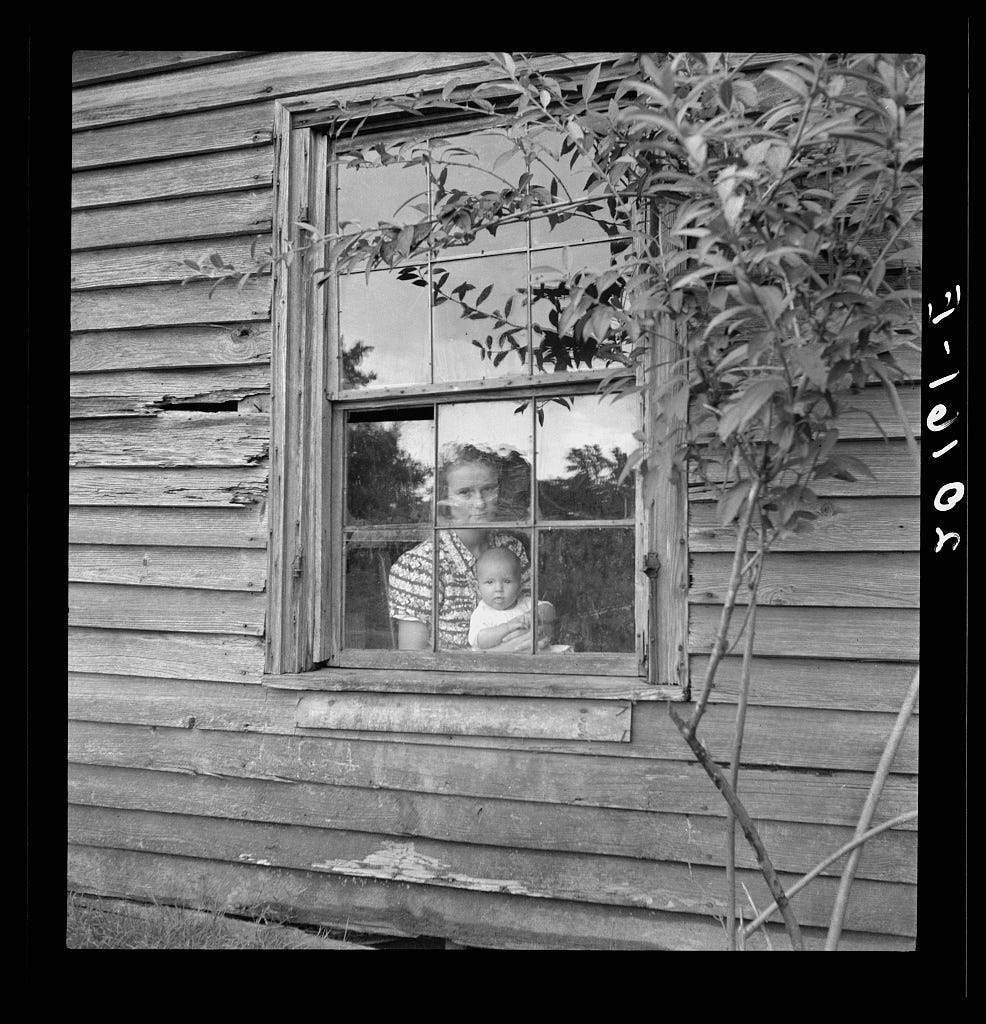
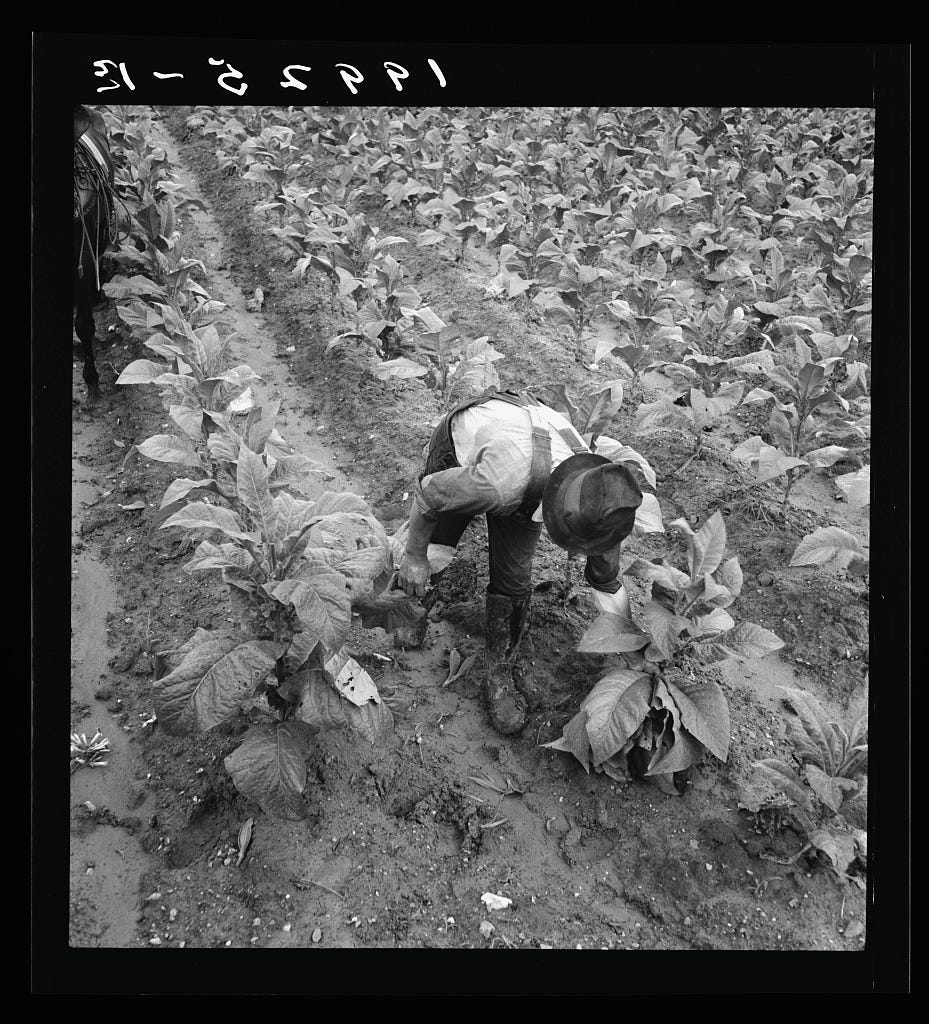
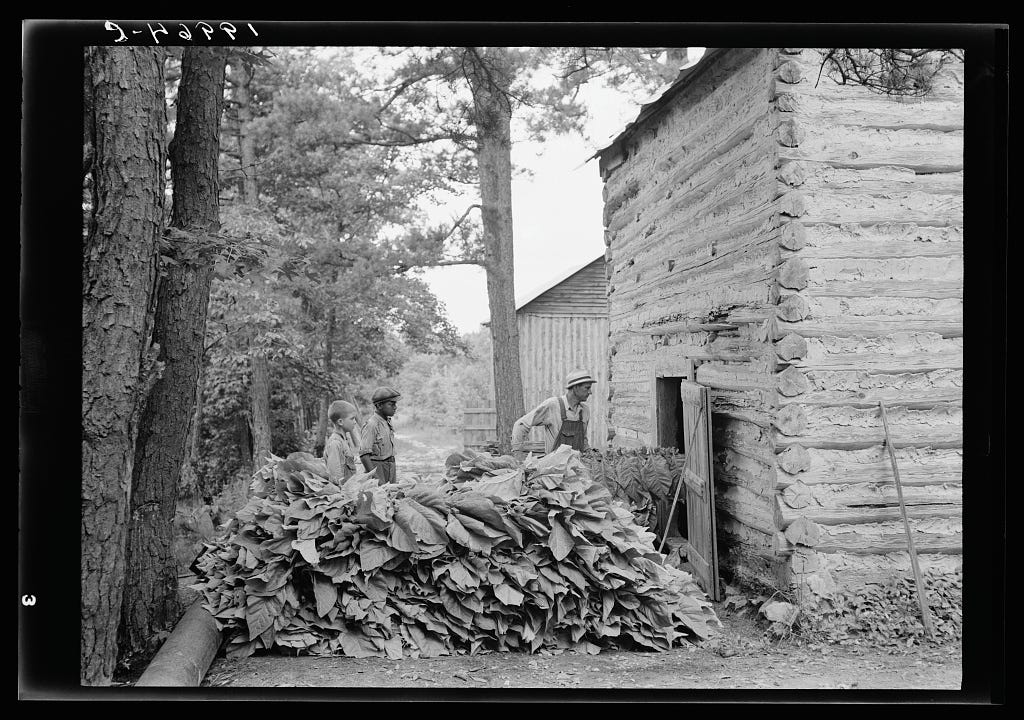
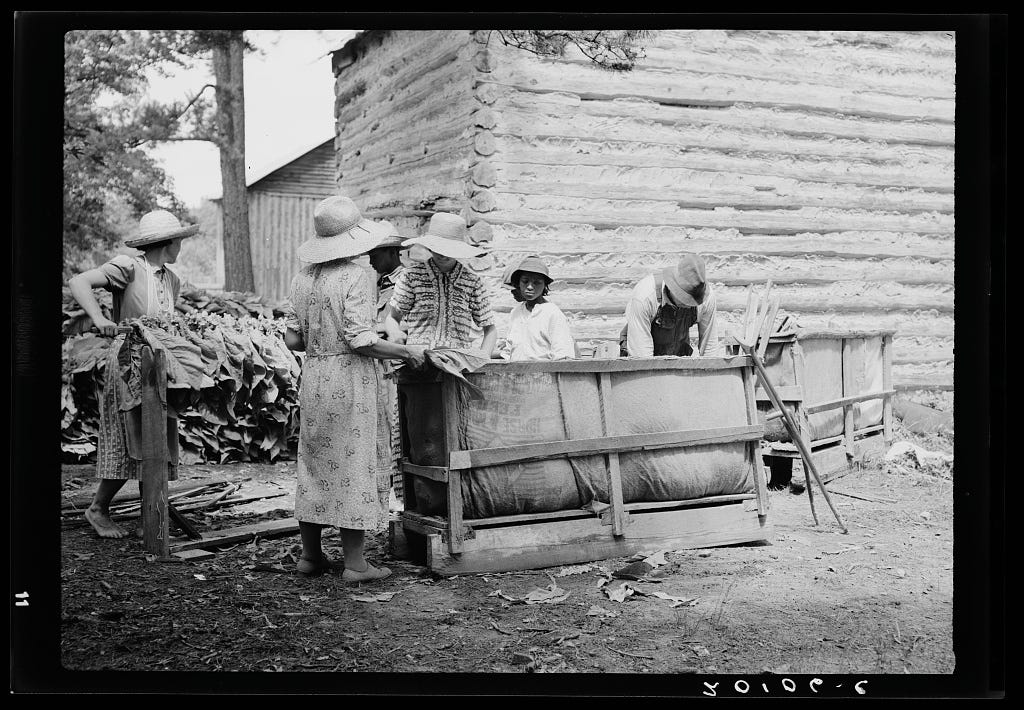
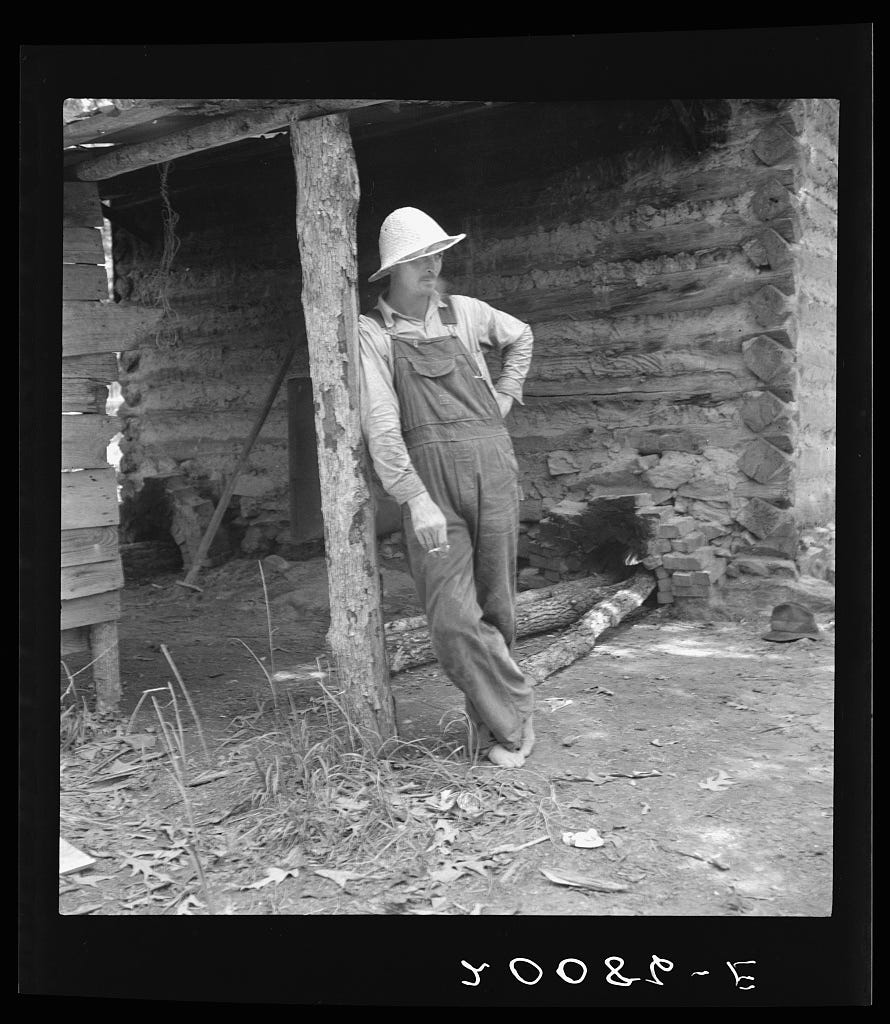
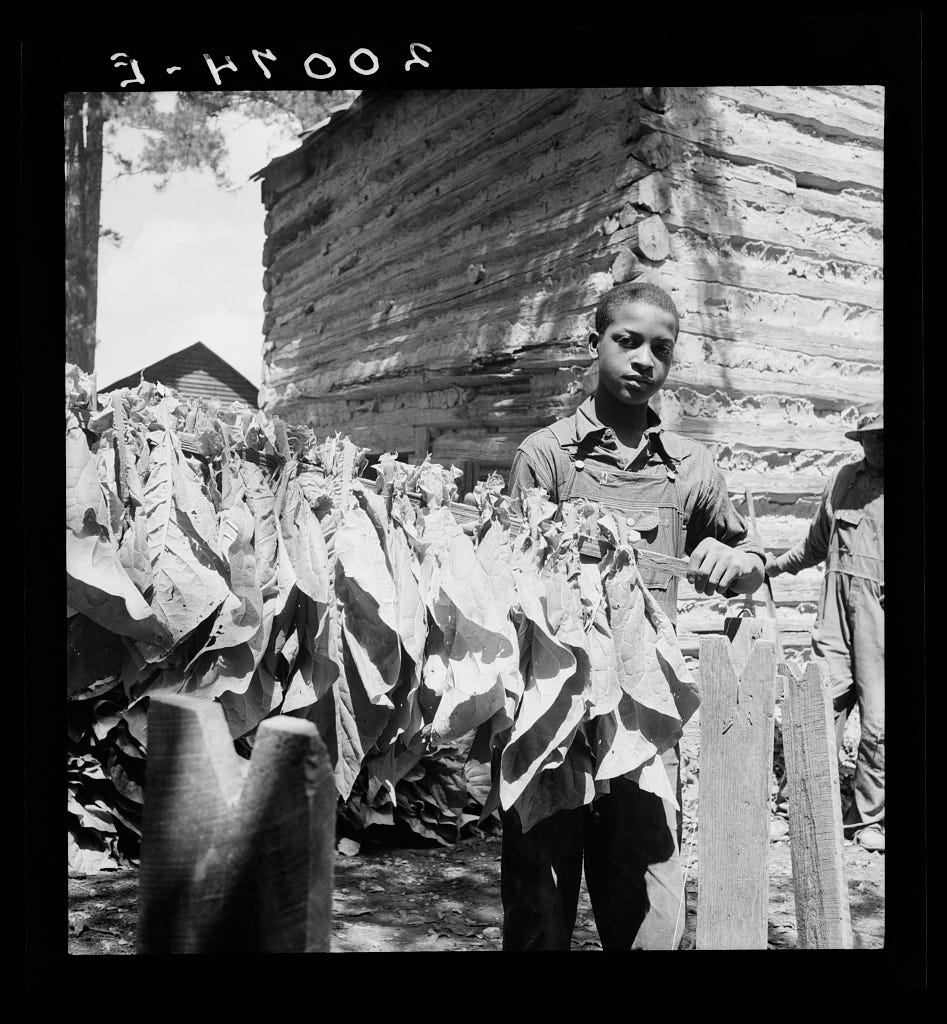
Source: Library of Congress
Finally, here are Lange’s words about what she observed:
Subject: Putting in Tobacco:
This process is also known as ‘saving’ tobacco; the word ‘priming’ is also sometimes applied to the entire process, although strictly this term describes the actual removal of the leaves from the plant. The process is also known as ‘curing tobacco,’ although here again this term applies strictly only to one particular part of the process.
1. “PRIMING.” Beginning at the bottom of the plant, the leaves are stripped; usually two or three bottom leaves are removed at one priming. Only the ripe leaves are primed, and ripeness is determined by the color of the leaf. When ripe, the leaves are pale yellow in color, although they are often difficult to distinguish from the green leaves. Hence the job of priming is something of an art, which is left to the men of the family or to those ‘women folks’ who are skilled at it. In the field picture, the men are priming for the second time, the ‘first primings,’ or sand leaves, having been removed. Noe the method of removing the leaves, the manner which they are held, and the care which is exercised to prevent bruising or breaking. [a list of 11 negatives follows]
2. “SLIDING TOBACCO TO THE BARN.” The primings are transported to the barns, here they will be tied or strung, in the ‘slide’ (also called sled). Note construction of the slide-frame of wooden strips, on a pair of wooden runners. The body of the slide is made of Guano sacks, and the entire structure is narrow enough to run between the rows of tobacco without breaking the leaves. In this instance to slides are in use; while one load of tobacco is being strung, the other slide is sent to the field for another load. [5 negatives]
3. “STRINGING THE TOBACCO.” At the barn, the tobacco is strung on sticks by the women and children, and those men who are not required i the field. The sticks are of pine, four feet long. The string is fastened at one end, and the leaves of tobacco in bunches of three or four, are strung on the stick alternately on each side. Note the notched ‘horses’ for holding the sticks while stringing. When a stick is filled with tobacco, it is removed from the horse and piled in front of the barn, where it remains until put up in the barn. Sometimes shelters are provided to keep the sun from the tobacco, after it is strung, since very hot sun will burn the tobacco. In this case two people are stringing, one of them an expert negro boy, and two or three people are ‘handing the primings’ to the stringer. [12 negatives]
4. “PUTTING IN THE TOBACCO.” At noon, after the last slide of the morning has come from the field, the tobacco which has been strung is hung from the barn. The barns are of four or five “rooms” (a room is the space between the tier poles; the barn in the picture is a four room barn, and will hold about 600 sticks of tobacco). Two men go up on the tier poles, and the tobacco is handed up to them. One room is filled at a time. In the barn picture, several people’s tobacco is being put in together; there are, in addition to the second primings mentioned, some first primings from another field. These are much inferior in quality of the second primings., and are covered with sand--hence the term ‘sand leaves.’ [7 negatives.]
5. “FIRING THE BARNS.” When the barn is filled, the tobacco is allowed to hang for several hours, sometimes over night, until the leaves are thoroughly wilted. Fires are then built in the furnaces, and the process of curing begins. The heat is kept at ninety degrees until the tobacco is ‘yellowed’ then is gradually raised until all of the leaf except the stem is cured, when the final stage, ‘killing out,’ is reached. The heat is usually raised rapidly until it reaches 190 or 200 degrees. Curing takes about three days and three nights. although under certain circumstances it may take longer. After the tobacco is cured, it is allowed to hang in the curing barn until it ‘comes in order’--absorbed enough moisture so that it can be handled without breaking--when it is taken down and packed in the pack house. Here it remains until it is stripped out. It is usually taken up and repacked once, so that it will not become excessively moist and mould. [5 negatives]