


A few months ago, I wrote an essay for a new(ish) publication out of Notre Dame called Virtues and Vocations. The editors asked me to contribute a piece on the theme of generosity, and so I tried to describe what this strange virtue looks like from where I stand. I can’t post the text here, so please give it a read when you have the time. (Here’s a link.) In the essay, I consider how the virtue of generosity, rather than justice, might offer a different perspective on the climate crisis. I worked in unfamiliar company (the president of Middlebury College kicks off the issue, for example), but I’m always grateful for the opportunity to write.
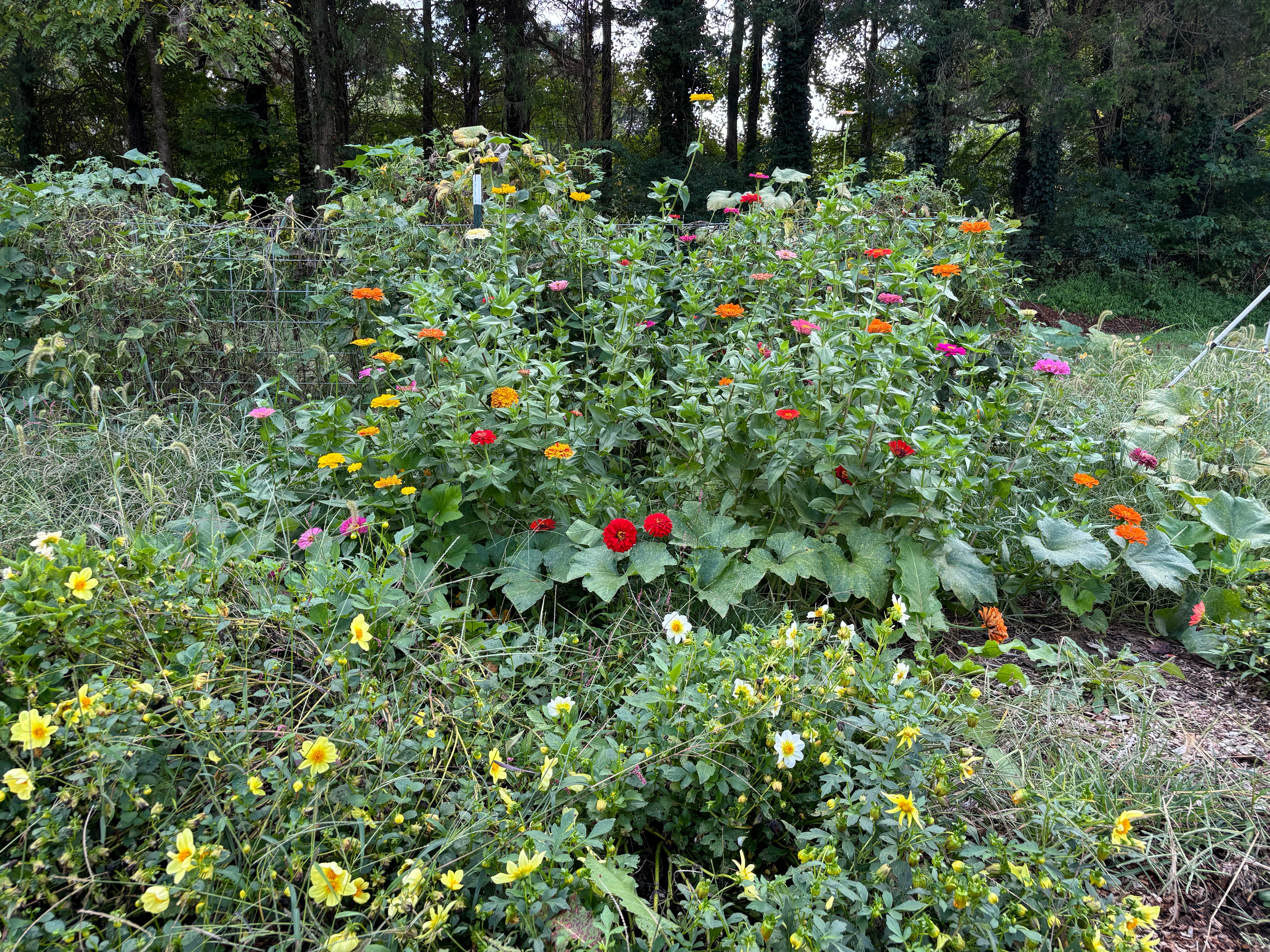
A glimpse of our fall garden, weeds and all. Photo by the author.
My wife, Goodie, has an essay coming out soon in Plough Quarterly. It’s about cows, motherhood, and interspecies entanglement. (Do you know what an alloparent is?) The essay is a total delight. I’ll be sure to post a link to that here, too. (For those curious about her sermons, the church has started posting transcripts to the website. Sign up here to get them each week.)
I’ve been thinking a lot about gardens–what counts as a garden, why we garden, who and what they’re for. It will likely become a chapter in a book. But in the course of reading, I came across this lovely poem by Pablo Neruda, the Chilean poet. Its title is Oda a la jardinera, or “Ode to the Gardener.” The poem’s subject is a “latter-day Eve,” as Robert Pogue Harrison points out. In the poem, Eve’s role in the garden merges with the role of the Creator. She touches the speaker’s breast (Adam?), and “trees bloom/ on my dream.” (In Milton’s Paradise Lost, Adam literally dreams Eve into existence.) Eve delves and digs the same substance, earth, of which her “hands” and her “heart” are made. I’m not usually one to champion free verse, but perhaps you’ll find it touching, like I did. Read on below.
Yes, I knew that your hands were
a blossoming clove and the silver
lily:
you had something to do
with the soil
and the flowering of the earth;
however,
when I saw you delve and dig
to uncouple the cobble
and limber the roots,
I knew straight away,
my dear cultivator,
that
not only
your hands
but also your heart
were of the earth,
and that there
you were shaping
a thing
that was forever
your own,
touching
the humid
door
through which
swirl
the seeds…
even so, love,
your hand
of water,
your heart of earth,
give
fertility
and power to my songs
Touching
my breast
while I sleep,
trees bloom
on my dream.
I waken and open my eyes,
and you have planted
inside of me
the darkening stars
that rise
in my song…
Selected Poems, 252-3
Hats off to alloparents. Neruda's images are so powerful, I feel the vibrations of his voice as I read, even in translation