


By the end of January, the pastures of our farm have given up the green that anchors the landscape around us and the work that we do on it. The sheep and cows, nibbling through the choicest clumps of grass, have left behind the remains of plants that have long been dormant. With longer days and warmer temps, the grasses will return with a raucous, almost unbelievable energy. But from now until April, the grays, browns, and tans dominate. Without snow, winter on our farm can feel a bit like a study in variations on the color taupe.
One species of grass that defies the monochrome of winter is broomsedge (Andropogon virginicus). The first thing to know about broomsedge is that it’s not a sedge (genus Carex). It also has other names. I’ve heard it called broomsedge bluestem, broom straw, broom grass, and whiskey grass. When dormant, its leaves and stems form tall, stiff waves that are a beautiful tawny copper. When it is growing, it tends to bunch together and maintains its erect posture even into winter and spring. This time of year, it looks like poorly bundled sheaves of wheat standing in a field.
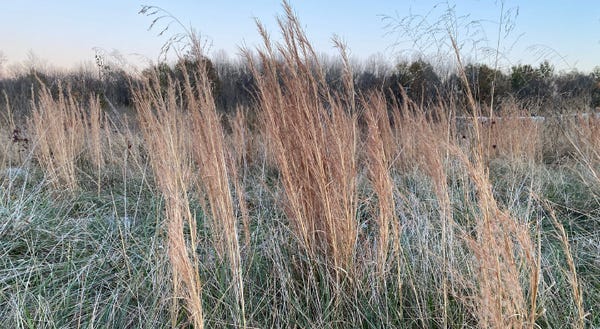
In the summer, broomsedge can be hard to detect. It has a soft, mild green that tends to blend in with other plants, and its leaves are fairly unremarkable. It comes on slowly in the spring and takes off in July, August, and September, when nearly every other plant around it is suffering from heat.
What’s funny about this plant is that it is universally reviled in the farming communities I am a part of. Any grazier will tell you that the problem with broomsedge is that nothing likes to eat it. It thrives in poor, acidic soil (North Carolina has lots of poor, acidic soil), and it is a particularly aggressive reproducer. When I first started farming, I was alerted to its almost malevolent ability to take over a field in two or three growing seasons. When I see a tuft of it on one of our farms, which is nearly every day, I wince a little: it means I haven’t grazed right, or the soil isn’t quite as it should be. To control its distribution of seeds, farmers will typically clip it with a bushog. In my experience, though, it’s impossible to maintain a perennial grassland full of native grasses without a little broomsedge. And if you give it some competition by letting other plants grow around it, it won’t take over. It seems to me that waging war against this plant is more about the farmer hiding the possibility of failure or inadequacy than it is about maintaining a healthy pasture ecosystem.
Lots of farmers describe broomsedge as an invasive species, but it’s nothing of the kind. Broomsedge is a perennial grass native to the Southeast. It has probably dotted the hills of our region for millenia. Once upon a time, it was important habitat for bobwhite quail and other birds that nest on the ground. In some grassland ecosystems in the northeast, it is the “primary meadow grass” and “the linchpin of any prairie restoration.” Broomsedge just so happens to grow in places where nothing else can. For that humble purpose it should probably be acknowledged, if not treasured.
The other day an elderly landowner called me over to talk about some patches of broomsedge in a field where we run cattle. She didn’t like them and asked if her husband could clip them with the tractor. I told her I had learned not to mind it much, so long as it behaves, and I asked her why she didn’t like it. She made a face, and then she said that seeing the plant reminded her of days growing up poor on her homeplace far away to the east. This time of year, her mother would make her and her siblings go out to the field and cut broomsedge, strip the leaves seedheads, and stack the stalks for brooms, brushes, and other tools. They were too poor to buy such things and so they had to make them. Those were painful memories, she said, and I wondered but did not ask about the source of her pain. I am interloper here, after all, more alien to the land around me than broomsedge. So I said sure, why not cut it all down. When I pulled up the next morning, the plant was gone.
Thanks for this informative bit about broomsedge. I like how you analyze its presence regarding the soil conditions. You recognize that it’s a native, and therefore you figure out how to live with it. I love that.
Growing up, I remember it as home to quail and meadowlarks in the field behind our house. We played hide and seek there too— so it evokes good memories for me. I love that somehow you asked the questions to hear your neighbors negative associations that prompt her to do violence. Things might change for the better if more of us engaged in such conversations.