


This past Tuesday Goodie and I attended an event hosted by the Theology, Medicine, and Culture program at Duke Divinity School. TMC gathers doctors and medical professionals from around the country to think about the practice of medicine can be shaped by moral and theological reflection. I was asked to speak about the health of bodies and the health of the land. After discussing the first six stanzas of this poem by bell hooks (and enduring a brief but shocking deluge), I shared the following remarks. Please note that at the end of this post I’ve included the quotations and citations my notes make reference to. Please reach out if something’s missing. JB
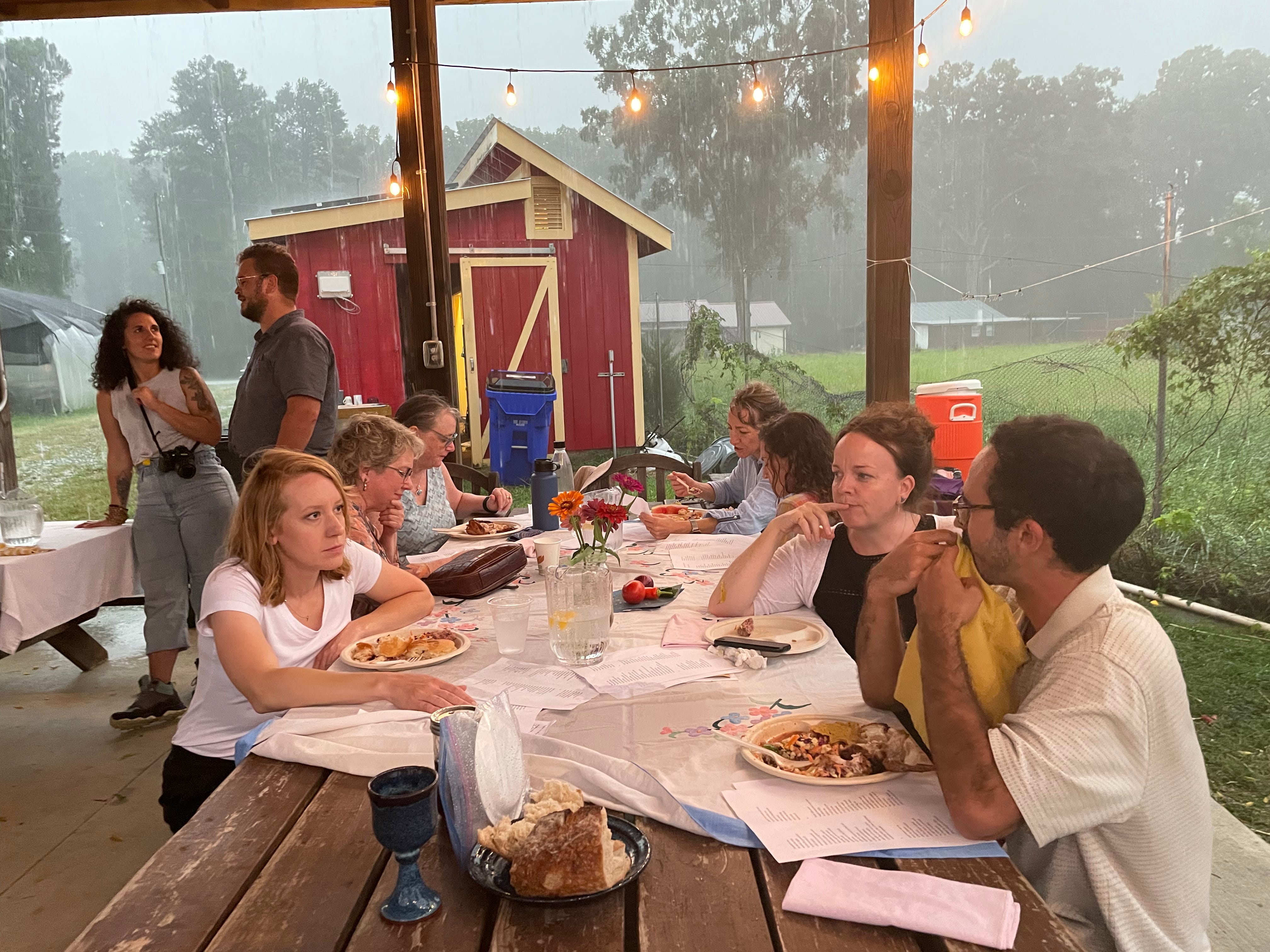
Normally it’s my duty to welcome you to our farm, where Goodie and I live and work, some twenty-five minutes north of Durham. But I am afraid we were not able to use our space this year: our house is undergoing a renovation, and all of our belongings are stored under the pole barn we use to gather guests. And so rather than ask you to rub elbows with our dining room furniture or mattresses, it’s my duty instead to repeat Amy’s welcome to the Duke Farm and extend our gratitude to her and to Saskia, the director of Duke Farm, who couldn’t be with us tonight.
My theme for tonight is the health of the land and the health of the body. This is a somewhat strange double theme to tackle because I am a farmer who happens to have a background in the academic humanities. I’ve never pretended to know very much about the health of the human body (I should say that I have been fortunate enough not to have to have become acquainted with the diseases of the human body. Thus far I’ve lived a fairly trouble free life). I probably know more about the maladies of cows than of human beings. I’m also not an ecologist: although I love learning about the natural world, I don’t specialize in it and can’t profess any great insights into its operation. So: why me? What insight might I have to offer to you tonight?I’d like to try to answer this question by asking how the practice of medicine and the practice of agriculture might be related. My intuition is that there is common ground between the forms of attention that are demanded of us in our different professions, between those who care for the body and those who till the earth and also keep it. And I want to begin the exploration of this common ground by considering a remark that the ancient philosopher, Aristotle, makes in his analysis of rhetoric, the art of persuasion.
When Aristotle is reflecting on how we might distinguish between different types of arts or skills, he makes a passing comment about how medicine is one of the “stochastic” arts (stochastike techne). The root for this word, stochastike, means to aim for the mark. At its best, Aristotle writes, medicine aims at the goal of restoring health to a person, but it can’t promise to always hit it. The best medical care sometimes, and sometimes frequently, fails. Aristotle is talking about ancient medicine here, and we probably can be sure that in 4th century BC, most of the time doctors didn’t hit the mark they were aiming for. But it is still the case that failure remains a characteristic experience of medical practice. It’s not possible to heal everyone. As much as medical science would like to pretend that death is avoidable, the fact of the matter is that our bodies break down and eventually fall into a state of decay that is irredeemable this side of eternity. And so mastery of the medical sciences is perfectly compatible with the occasional, and in the case of some diseases, necessary failure in healing a person.
Consider how this is different from the art of construction or building. I mentioned earlier that we are renovating our house. If my builder told me that 10% of the time his houses fell down or failed in some catastrophic way, I would turn around and go find another builder. (One reason I’m not in charge of the project is that I want to lower these odds; if I were in charge, I’d put failure at 30 or 40%). Catastrophic failure isn’t something that characterizes the mastery of homebuilding. Outside of a hurricane or tornado or a hidden flaw in building materials, it’s not common for houses to fall down. That’s because the construction of a house begins in the mind of the architect and the builder, who make sketches, calculations, and designs for how things should work. Ideally, they bring a wealth of experience to each new project. They see and have control over the entire process, beginning to end. If at the end of the process the building fails, then, it is a sign of a flaw in the builder himself, and not in the art of building.
Not so with doctors and medical professionals. “It does not belong to medicine to produce health,” Aristotle writes, “but only to promote it as much as is possible (Aristotle, Rhetoric, 1355b12). Success is by no means guaranteed. Uncertainty lurks in every case, and I suspect that no doctor can ever claim to understand in any absolute sense what is going on in a given patient. This is not the fault of the professional or of our tools but something intrinsic to the way that medicine works. Doctors and nurses don’t design and build the human bodies they work on. Instead, they receive bodies that, for all their intricacy and beauty, frequently break down and require maintenance (if not outright overhaul). Part of what it means to practice medicine, then, is to receive an unbelievably complicated system that you didn’t design, and that for some unknown reason doesn’t work properly, and then figure out how (if possible) to restore it to health. Uncertainty and probability are built into the enterprise.
The contemporary philosopher, Matthew Crawford, suggests that the practice of medicine, and indeed any craft whose mastery is compatible with failure, requires a unique form of moral habituation. “[The] experience of failure,” Crawford writes, “tempers the conceit of mastery. The doctor and auto mechanic [alike] have daily intercourse with the world as something independent, and a vivid awareness of the difference between self and nonself.” (81). What’s needed, then, is a keen and humble attentiveness focused on the thing that is wholly outside of you and not subject to your whims and wishes. Unlike the builder or the historian or the philosopher, success depends not on completion of a specific project that began in the mind’s eye, but on a capacity to see and perceive a broken body or a diseased mind in real time. The broken body before you is given to you; you didn’t ask for it to be the way that it is, and you don’t have any control over what it has done or what it will do. It’s just your job to see what’s wrong and care for it the best you can. What’s needed, then, is a habit of attention that has both cognitive and moral dimensions. Getting it right,” Crawford continues, “demands that you be attentive in the way of a conversation rather than assertive in the way of a [philosophical] demonstration” (82).
It may be tempting to suppose that agriculture belongs among the productive arts. After all, the goal of farming is to bring forth food from the abundance of the earth. Farmers start with seeds, and after planting, fertilizing, weeding, they end–hopefully–with a bountiful crop. On this construal, it would be difficult to contest the claim that modern industrial agriculture has perfected farming’s productive capabilities. Take the example of commodity wheat, or winter red wheat as it’s known in agricultural science. Winter wheat is the most popularly grown cereal grain on the planet. Since the plant was hybridized in the 1940’s and 50’s, yields have skyrocketed to 80 and 90%. Prior to industrialization, yields typically came in around 30-40%. Coupled with the invention of ammonium nitrate, a synthetic fertilizer, and an arsenal of pesticides and herbicides, wheat has enabled farmers to feed more people than ever before, fueling the growth of agricultural economies in our own country and in the furthest reaches of the globe.
It has become necessary to ask, though, at what cost our society has made these gains, and whether there is in fact something missing when we approach agriculture solely from the perspective of production. Is it possible that care for the health of the lands\ has no role to play in agricultural production? There are many points of entry into these questions (cultural, social, biological, genetic), and many of them are no doubt familiar to you. But I want to focus, briefly, on what industrial agriculture has done to the natural world.
Nowadays it has become commonplace for industrial agriculture to strip away everything from the landscape that can’t be extracted and converted into a cash crop: all manner of wild flora and fauna; keystone species that range in size from hawks, kestrels, owls, wolves, and mountain lions to predatory microarthuropods like soil mites that live within what’s called the soil food web, an ecosystem where organisms are measured by the micron, not the meter; wetland and prairie ecosystems that have been destroyed or have disappeared. It has polluted waterways, oceans, and underground aquifers with its effluent and fertilizer runoff. It’s not an exaggeration to say that we are living through an ecological crisis the likes of which the world haven’t seen since the dinosaurs disappeared. Species loss is occuring at a rate that far outstrips the number of new species biologists discover each year. The widespread loss in biodiversity has led many scientists to conclude that we are living through a sixth mass extinction event, in which Industrial agriculture has played a central, if not solitary, role.
Even something as innocuous as a cereal grain like wheat has its own role to play in this tragedy. Over the course of the last seventy-five years, one, specific, hybridized variety of wheat has become the gold standard of cereal grain production all over the globe. The conflict between Russia and Ukraine has reminded us that in some places, wheat functions almost like currency. In that same time frame, hundreds of local varieties and heirlooms have been lost to memory. Farmers abandoned them in favor of higher yielding strains like winter red. But these heirlooms were in many cases adapted to thrive in some of the most inhospitable places on the planet. To put the matter simply, we really could have used that adapted biodiversity to figure out how to grow wheat in increasingly unpredictable weather conditions. It may very well be that the attempt to feed more people in the 20th century has robbed future populations of the genetic diversity they’ll need to feed themselves in the future.
Consider, too, the routine application of ammonium nitrate to grasses like wheat (wheat is a hybrid of goat grass, a wild grass that grew on the mountainsides of Turkey, and emmer, an ancient grain that was bred from einkorn a different species of goat grass). Recent research in soil science suggests that the application of synthetic fertilizer disrupts a plant’s ability to produce exudates, a sticky, starch-like substance that is secreted by a plant’s roots. Exudates feed hundreds of species of microbes in the soil, and the microbes in turn give back to the plant trace elements from the soil that the plant needs to flourish. When a farmer sprays his fields with synthetic chemicals, he is disrupting these complex relationships, and the more he relies on them the deeper the dysfunction likely goes.
There have been efforts in our nation’s history to conserve what industrial agriculture has marred, disfigured, or destroyed: the birth of institutions like the NRCS (Natural Resources Conservation Services) and the EPA come to mind. But given the scale and depth of the problem, I wonder whether we have missed something fundamental about the nature of agriculture as a human practice.
I’d like to return to what I drew out from Aristotle’s comment about medicine: its attentiveness to the body and the world outside the mind; its acquaintance with uncertainty and failure; the moral and cognitive dimensions of attention; the intellectual humility that’s required of anyone who wishes to succeed in it. All of this rings true to me about the type of farming that goes by the name of regenerative farming or agroecology. On this alternative view, producing food is just one part of sound agricultural practice: attentiveness to the whole context of production is an absolute necessity. This is because we are working with biological and ecological systems that we didn’t invent, and therefore need to submit to in order to understand them. The promise of agroecology in particular is that it is possible to farm with biological systems, not against them; to receive these systems as they are and try to manipulate them in ways that produce food efficiently but that do not disrupt or destroy.
Failure is an inevitable part of this process. Ask anyone who has kept a farm or a garden and they will probably tell you that failure can come crashing down on you at any moment. But at the end of the day, with trial and much error, we can build resilient food systems that leave ecosystems intact and produce enough food for people to eat. That this is possible is one of the insights of agroecological science; the roots of this discipline lie in the study of indigenous farming communities in Mexico and Central America. These communities never adopted the practices of industrial agriculture. We can do this, but whether or not we actually will move beyond the industrial model is a separate question entirely. (and related to Wendell Berry’s attack on industrial medicine: I take it you all have read “Health is Membership.” What would it look like to envision a medical system that takes seriously the health of the whole human? The health of an entire community?)
It seems to me that what is needed now more than ever is the cultivation of forms of attention that can do justice to the beauty and dignity of biological systems. We cannot fix what we cannot see, and as the philosopher Iris Murdoch reminds us, “by opening our eyes we do not necessarily see what confronts us.” This is because vision is connected to virtue: what we see is in no small part a measure of the type of people we have become. Left to our own devices, she writes, “we are anxiety-ridden animals. Our minds are continually active, fabricating an anxious, usually self-preoccupied, often falsifying veil which partially conceals the world. If quality of consciousness matters, then anything which alerts consciousness in the direction of unselfishness, objectivity and realism is to be connected with virtue” (82). For those of us in medicine or agriculture, vision requires us to submit to the dazzling complexity of the human body and of soil science, and to submit to it in wonder and in awe. From this perspective, humility may be our most important professional virtue: humility “not [as] a peculiar habit of self-effacement,” Murdoch says, but as a “selfless respect for reality” (93).
Murdoch, like Plato before her, thought that the habit of attention was cultivated through a variety of human activities: intellectual disciplines like math, science, history, the study of medicine; mastery of foreign languages; and especially through art and literature, which she describes as a kind of moral “goodness by proxy” (85). The sheer variety of human activity and excellence is not a mark of the world’s fundamental disorder but of the infinite complexity of reality. But there is also an easier way to hone your attention than devoting your life to one of these activities. It’s available to anyone who retains the faculty of sight. Here is Murdoch describing a kestrel, a small, beautiful bird of prey that she observes flying outside her window:
(quote 3) “I am looking out of my window in an anxious and resentful state of mind, oblivious of my surroundings, brooding perhaps on some damage done to my prestige. Then suddenly I observe a hovering kestrel. In a moment everything is altered. The brooding self with its hurt vanity has disappeared. There is nothing now but kestrel. And when I return to thinking of the other matter it seems less important. And of course this is something which we may also do deliberately: give attention to nature in order to clear our minds of selfish care.”
When we withdraw from our habitual attachments and contemplate some aspect of creation, we encounter “a perfection of form which invites unpossessive contemplation and resists absorption into the selfish dream life of the consciousness” (83). The same thing happens in the experience of great art: we are unselfed, drawn out of our usual psychological addictions and invited to commune with something that is wholly outside of us. In this talk, I’ve suggested that a similar unselfing can take place in the practices of medicine and agriculture. If this is true, then all the more reason for us to gather together in spaces like this, across disciplinary divisions and diverse trainings, and share how what we pay attention to forms and informs our lives. After all, if creation is one whole seamless garment that lies in the hands of its creator, we do justice to its unity by learning and sharing with one another around a meal, attentive to words of our neighbors, even though we will never see the whole or contemplate its infinite variety in this life.
HANDOUT
Aristotle: stochastic arts [stochastikai technai] vs. productive arts [poietikai technai].
“It does not belong to medicine to produce health, but only to promote it as much as is possible,” Aristotle, Rhetoric, 1355b12. See also Katarina Ierodiakonou, “Alexander of Aphrodisias on Medicine as a Stochastic Art,” in Ancient Medicine in Its Socio-Cultural Context, Volume 2 (Leiden: Brill), 473-85.
From Iris Murdoch, “The Sovereignty of Good over Other Concepts, ” in The Sovereignty of Good (Oxford, 1970):
“By opening our eyes we do not necessarily see what confronts us. We are anxiety-ridden animals. Our minds are continually active, fabricating an anxious, usually self-preoccupied, often falsifying veil which partially conceals the world. Our states of consciousness differ in quality, our fantasies and reveries are not trivial and unimportant, they are profoundly connected with our energies and our ability to choose and act. And if quality of consciousness matters, then anything which alerts consciousness in the direction of unselfishness, objectivity and realism is to be connected with virtue.” (82)
“Beauty is the convenient and traditional name of something which art and nature share, and which gives a fairly clear sense to the idea of quality of experience arid [sic] change of consciousness.” (82)
“I am looking out of my window in an anxious and resentful state of mind, oblivious of my surroundings, brooding perhaps on some damage done to my prestige. Then suddenly I observe a hovering kestrel. In a moment everything is altered. The brooding self with its hurt vanity has disappeared. There is nothing now but kestrel. And when I return to thinking of the other matter it seems less important. And of course this is something which we may also do deliberately: give attention to nature in order to clear our minds of selfish care.” (82)
“Art, and by ‘art’ from now on I mean good art, not fantasy art, affords us a pure delight in the independent existence of what is excellent. Both in its genesis and its enjoyment it is a thing totally opposed to selfish obsession. It invigorates our best faculties and, to use Platonic language, inspires love in the highest part of the soul. It is able to do this partly by virtue of something which it shares with nature: a perfection of form which invites unpossessive contemplation and resists absorption into the selfish dream life of the consciousness.” (83)
“If I am learning, for instance, Russian, I am confronted by an authoritative structure which commands my respect. The task is difficult and the goal is distant and perhaps never entirely attainable. My work is a progressive revelation of something which exists independently of me. Attention is rewarded by a knowledge of reality. Love of Russian leads me away from myself towards something alien to me, something which my consciousness cannot take over, swallow up, deny or make unreal. The honesty and humility required of the student–not to pretend to know what one does not know–is the preparation for the honesty and humility of the scholar who does not even feel tempted to suppress the fact which damns his theory. Of course a techne can be misused; a scientist might feel he ought give up a certain branch of study if he knew that his discoveries would be used wickedly. But apart from special contexts, studying is normally an exercise of virtue as well as talent, and shows us a fundamental way in which virtue is related to the real world.” (87).
“In intellectual disciplines and in the enjoyment of art and nature we discover value in our ability to forget self, to be realistic, to perceive justly. We use our imagination not to escape the world but to join it, and this exhilarates us because of the distance between our ordinary dulled consciousness and an apprehension of the real.” (88).