


America was a gale blowing constantly in his face. By America he meant White America and by White America he meant anything about America he didn’t like. The wind hit him harder than it did small men; they thought America was a breeze but he heard it rage, even when branches were still and the American flag hung down the side of buildings like a star-spangled scarf--even then he could hear it rage. His response was to rant back, to rush at it with all the intensity that he felt it rushing at him, two juggernauts hurtling toward each other on the road the size of a continent.
Geoff Dyer on Mingus, But Beautiful, 103.
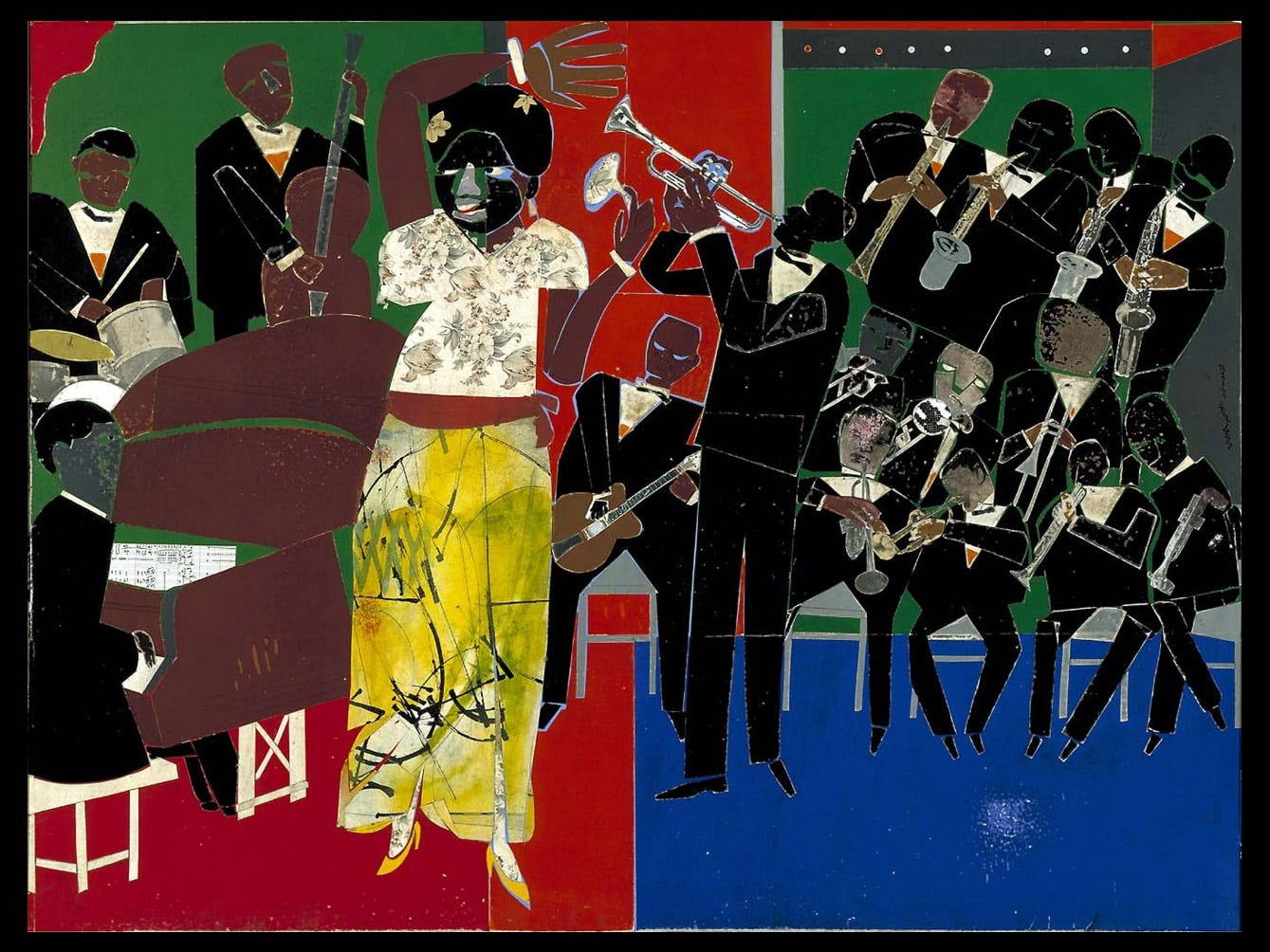
Romare Bearden, Empress of the Blues, 1974, acrylic and pencil on paper and printed paper on paperboard, Smithsonian American Art Museum
Geoff Dyer’s But Beautiful is a strange book. It’s a book about jazz, which means you can probably find it on the bookshelf of every white dude who ever wore a pork-pie hat. Unlike so many of its shelf-mates, though, the book isn’t awful. Against the odds, it manages to be quite good. First published in 1991, 35 years ago exactly (I was five years old!), But Beautiful examines the lives of seven musicians and composers whose work spans much of the first half, and at most two thirds, of the 20th century: Lester Young, Thelonius Monk, Bud Powell, Ben Webster, Charles Mingus, Chet Baker, Art Pepper. But even just listing these names makes the book sound more straightforward than it really is. In Dyer’s telling, the identity of each of these players is submerged in conversation and in daily routine, not unlike the distinctive features of the art that the musicians make. In some chapters, you pass through tens of pages before realizing who it is you’re reading about. The same is true for many jazz records. Unless it’s a famous recording, or a beloved one, you’ll have to look at the liner notes to know who’s playing.
Still, the book works. Dyer’s prose renders the lives of these figures so lifelike and interesting that the music seems to flow effortlessly from the lifeworlds he conjures up. Here is Dyer’s account of what it felt like to listen to Thelonius Monk play the piano:
He played each note as though astonished by the previous one, as though every touch of his fingers on the keyboard was correcting an error and this touch in turn became an error to be corrected and so the tune never quite ended up the way it was meant to. Sometimes the song seemed to have turned inside out or to have been constructed entirely from mistakes. His hands were like two racquetball players trying to wrong-foot each other; he was always wrong-fingering himself. But a logic was operating, a logic unique to Monk: if you always played the least expected note a form would emerge, a negative imprint of what was initially anticipated. You always felt that at the heart of the tune was a beautiful melody that had come out back to front, the wrong way around. Listening to him was like watching someone fidget, you felt uncomfortable until you started doing it too. (40)
Can you imagine a lovelier description of Monk’s melodicism, of what it feels like to listen to him improvising by himself? If you’ve ever spent time listening to the solo recordings, you’ll recognize what Dyer’s describing immediately. It’s not for nothing that Keith Jarrett says that But Beautiful is the best book on jazz ever.
Passages like this are rare, though. What Dyer spends most of his time doing is accumulating sketches of the artists as ordinary people. What did they look like, and what must it have been like to be around them, to be them? The typical procedure is to draw a portrait of the artist as a grown man, typically a broken one, and then find in the life some buried link to the art. Sometimes a chapter will begin by positing a break between the person and the art (addiction, paralysis, madness) and then works backwards from the bombed-out remains to the art that once was. What is left, the book wants to ask, if you distill the art and remove it from the person who gave their lives to it? By the end of the book, the characters end up looking a lot like the worn-out instruments they’ve been forced to give up: tattered, bruised and banged up, not longer shiny, sleek, seductive.
Dyer draws on a wide body of research, interviews, and archival materials to do this. A lot of his material is made up, as he readily admits in the preface. Is the book fiction, then? Yes, but also, not quite. Historical fiction? Technically, yes, but the disjointed form makes it feel less like a cohesive novel and more like an impressionistic collage. From chapter to chapter, Dyer’s impulse is always the same. Find some way to sync the shape of a person or personality to the shape the art took. The “logic” of Monk’s was always just the logic of Monk the man. “[Monk] made no concessions in his music,” Dyer writes, “[he] just waited for the world to understand what he was doing, and It was the same with his speech [...] He just waited for people to learn to decipher his modulated grunts and whines.”
Life always leads back to the music, no matter how far away you get from the stage. The invitation is to see the life as a kind of coda or commentary on the music itself, as if the music were could be explicated best by getting to know the person who made it. There’s nothing really wrong with this kind of invitation, but how far does it actually take you in understanding the music? Quite a lot of bad music journalism and criticism operates off of the same impulse. It’s motivated by a kind of dollar-store psychology, an insistence on some necessary, intrinsic link between a type of person, sometimes called “a genius,” and the quality of the art. The problem is that great art frequently has absolutely nothing to do with what a person is or was like.
But Beautiful tries to avoid this trap by insisting on the importance of individuality to the genre’s understanding of itself. In an afterword, Dyer explains that the point of jazz music, indeed, the goal of becoming a jazz musician, is a mastery of form that spills over into a unique, authoritative personal style. Think Coltrane’s sheets of sound or Davis’s Harmon-mute. It doesn’t start that way, of course. Jazz begins with shameless imitation. You learn the compositions, then how to improvise in someone else’s style, and then and only then do you develop your own. It’s a sign of individual freedom and facility, of having mastered the language, that you have your own recognizable signature within the musical tradition.
Part of what Dyer is trying to do is rescue the reputation of jazz from Adorno’s famously austere rejection of it and, indeed, of all black popular music. “Jazz and pogroms go together,” Adorno once wrote in an essay published in 1936, waving away the whole genre as kitsch in blackface. At the level of form, Adorno claimed that no matter the improvisatory dash the jazz artist performed, his or her musical freedom was always reeled in, totalitarian style, by the swing of the rhythm section. Freedom, for jazz musicians and for black folks, was a cruel joke. Dyer tries to counter this by insisting that rhythm actually enables the music to become a kind of living, embodied critique of itself, always tugging and toying at the possibilities in the notes that came just before. That’s what jazz is, relentless self-critique; it is also what it means.“From time to time in his solos a saxophonist may quote from other musicians, but every time he picks up his horn he cannot avoid commenting, automatically and implicitly, even if only through his own inadequacy, on the tradition that has laid this music at his feet” (185). At its worst, the critique verges on self-satire. At its best, it pushes the form into new musical terrain. Somewhere in the middle lies the vast majority of jazz compositions, melodies, formulas, each one a former innovation-turned-standard. The modernism of jazz, he implies, may be more thoroughgoing than Schoenberg’s or Stravinsky’s.
There’s something to Dyer’s argument. Ornette Coleman, one of the most important jazz artists of the twentieth century, once said that “the best statements Negroes have made, of what their soul is, have been on tenor saxophone.” A kind of historical or technological correlative comes into play at the moment of jazz’s ascendancy in popular culture. In the same way that the invention of the violin coincides with the emergence of philosophical subjectivity in the seventeenth century, so the rediscovery of the saxophone’s hybridity coincides with the rise of freedom movements and the Civil Rights Era. It looks like a brass instrument but its mechanism makes it a woodwind. It is an instrument, Adorno thought, that “mutilates” gender difference in its being and in its sound. It sounds like the cry of the slave or the sharecropper, male or female or both. For this reason it was particularly suited to the lamentations of the oppressed. Through the saxophone, “jazz becomes a medium representative not only of a people but, implicitly, of a century,” Dyer writes, “a medium that expresses not simply the condition of the black American but a condition of history” (194).
Dyer is way too polite. Adorno couldn’t be more wrong about jazz if he tried. The thing that I’m not sure about is what Dyer’s rescue-efforts leads him to say about the ensemble in the development and articulation of the individual. It’s plain that Dyer sees jazz as a metaphor for individual freedom, for the striving of the individual with and against the collective, each member constantly seeking to outdo the other. I can certainly think of some jazz records that sound like this, but does it really make sense to think of the genre itself in terms of freedom negatively construed—freedom from something, or the absence of constraint? Part of the problem I’m trying to articulate has to do with the form of the book itself: seven jazz artists, all more or less operating independently of each other, none, so far as I am aware, ever having shared the stage with one another. A book might work this way, but the music doesn’t.
Take for example Dyer’s chapter on Mingus. Repeatedly in this chapter of the book, Dyer connects Mingus’s combustible personality to the howls and yelps and screams in his music:
He bullied his way into making himself heard on every instrument. Miles and Coltrane sought musicians whose sound would complement their own: Mingus sought musicians who offered a version of himself on different instruments. Always dissatisfied with his drummers, he had just given his percussionist a public keelhauling when he met a kid of twenty named Dannie Richmond, who had been playing drums for only a year. Mingus force-taught him to play exactly as he wanted, molding him in his image.
--Don’t play that fancy shit, this is my solo, man.
Dannie stayed with him for twenty years, finding his musical identity only by subsuming it to Mingus’. The fatter Mingus got, the thinner Dannie became--as if even his metabolism adjusted itself in equilibrium with Mingus’.
--Playing with him, there were times when you were terrified, then there were other times when you blew with more exhilaration than you ever felt with anyone else, feeling less like a band than a charging herd as Mingus’ shouts of abuse turned into hollers of encouragement:
--Talk about it, talk about it, talk about it. His voice cracking like a whip over the backs of horses:
Yah, yah, yah.
When the music reached a pitch of intensity, achieved a level of pressure even higher than that inside him, a momentum so urgent that nothing could get in its way and everyone looked like they were hanging on for grim death--that was when he hollered and whooped above the music, urging it on so that he could feel the calm of the hurricane’s eye, yelling and howling like Frankenstein ecstatic and aghast at the monster he has unleashed, delighted by the thought that it is all but beyond his control. Mingus happy--nothing could beat the thrill, the rush of that. At full tilt the band felt like sprinting cheetahs, cheetahs chased by an elephant that always looked as though it might trample them underfoot.
“Music was just part of the ever-expanding project of being Mingus,” Dyer concludes. Perhaps that’s true of specific recordings. Is there anyone else in the world who would have, let alone could have, made Cumbia and Jazz Fusion? And in Dyer’s defense, there are plenty of interviews with fellow musicians who paint him as a kind of tyrant of the stage. He was kicked out of Ellington’s band for chasing a trombonist off stage with a fire-axe. But when I listen to a performance of a piece like Wednesday Night Prayer Meeting from the 1960 Antibes Jazz Festival, with Booker Ervin on tenor sax and Eric Dolphy on alto, I feel compelled to say that something very different is happening than the musical elaboration of a unique personality. The recording is something else entirely: one giant, collective, improvisatory yawp released in the atmosphere. The whole thing sounds like a communal prayer in 6/4 time--not a prayer in the confessional, like Coltrane’s Love Supreme, but the prayer of a whole congregation, a whole people, their voices raised in unison but also, through the unity they achieve, enabling the individual to cry out:
In a typical reminiscence, [Mingus] tied “Wednesday Night Prayer Meeting” “to a form of music I heard as a kid. My mother used to go to church on Wednesday night. There was always clapping of hands and shouting. Methodist or Holiness Church. Holiness was a little louder in order to stir up the spirits. the dead spirits. People went into trances. Women shouted and rolled on the floor.” (Freedom Is, Freedom Ain’t, 165).
The sum of Wednesday Night Prayer Meeting is greater than its parts, even greater than Dolphy’s ululating solo that begins around the five minute mark. It has to be heard to be believed. The whole time, Mingus’s bass playing is in the background, carving out a subterranean, ogre-like pulse behind the horn section. He never solos. The only time you hear the bass by itself is when it performs a little invocation, a call to worship, at the very beginning.
In his book on jazz and the civil rights movement, Scott Saul points out that black activists and musicians of the 50’s and 60’s were equivocal about the concept of negative freedom enshrined in documents like the Bill of Rights. Freedom from was different from freedom to, the freedom to become and to belong. In musical terms, negative freedom, to be totally free of anyone else’s playing, to play whatever you felt like, made little sense to jazz musicians. “The dynamism of hard bop depended on the tension and interplay between the members of the group,” Saul writes. “When once musician ‘infringed’ on the rhythm or harmonic space of another musician, it was usefully re-conceived as a provocation, a license for bold counter-response.” Even a free-jazz impresario like Coleman insisted that the work of his ensemble was “at all times a group effort” (15-6, 10). Across his writings, Martin Luther King, Jr. derided the so-called “freedom of the will” or the freedom of choice, as if such a thing could be isolated from the whole person and the community that made them and to which they belong. The freedom to self-determine only made sense if you had something to become, a people to belong to, a people to become.
***
I have been thinking about the tension between these different kinds of freedom this week as I reflect on the news out of the Supreme Court, the decision that was handed down on the case called Louisiana vs. Callais. And I have tried to lean in and listen more closely to the jazz of the civil rights era, hard bop, to the delicate interplay of collective freedom and personal freedoms that make the music possible.
As countless outlets have reported, the Court’s conservative majority ruled that Louisiana’s two black districts constituted an unconstitutional racial gerrymander. The centerpiece of the Voting Rights Act, Section 2, the part that makes it illegal for states to provide minorities with less opportunity than the majority in the election of representatives, has been rendered null and void. Louisiana’s legislature, majority conservative, now has the legal freedom to carve up its electoral maps in whatever way it sees fit, regardless of demographic make-up. The population of Louisiana is a third black. All of its districts will now be majority-white. Literally days later, the Tennessee legislature capitalized on the ruling and dismantled the state’s lone black district.
Other states, the southern states, will follow this barbaric tide. My home state, Mississippi, will do everything it can to follow the course of white power. For now, it seems, North Carolina is stuck with the maps it has until 2030.
Listening to this extraordinary music I am reminded of several things at once: the inherent shittiness of so much of white America, past, present, and future, the atavism and the revanchism swirling on the surface like a slick of oil. The grift and the corruption and the political despair that go all the way down. Suddenly, no one seems to know how to live well anymore, no one knows what good work or good land is and how to protect and preserve it--with our hands, not anyone else’s. No one seems to know what hope is, what joy might look like. There are few left among us can recognize beauty, it seems. Above all, no one knows how to belong. Meanwhile, I wonder, how is this the country that my children will inherit?
In 2013, the journalist George Packer claimed that America was living through what he called the great “unwinding”: a long, slow unravelling of local sociality and communal solidarity that began in the late 70’s. How did the unwinding happen? The war against unions, the war against local business, the war against public education; deregulation, globalization, and the legislative removal of guardrails around campaign finance; the subprime mortgage crisis; our politics of money. What has taken the place of community? Organized capital.
How far will the unwinding go? Who knows. Here’s what I do know: grab your people, love them, do not let them go.
Postscript: someone on Youtube has uploaded a live video recording of the same performance of Wednesday Night Prayer Meeting that I linked above. The audio isn’t as good, and there are some interesting cinematographic choices, but it’s still worth watching to see the band play together.
Beautiful essay, Jack.