


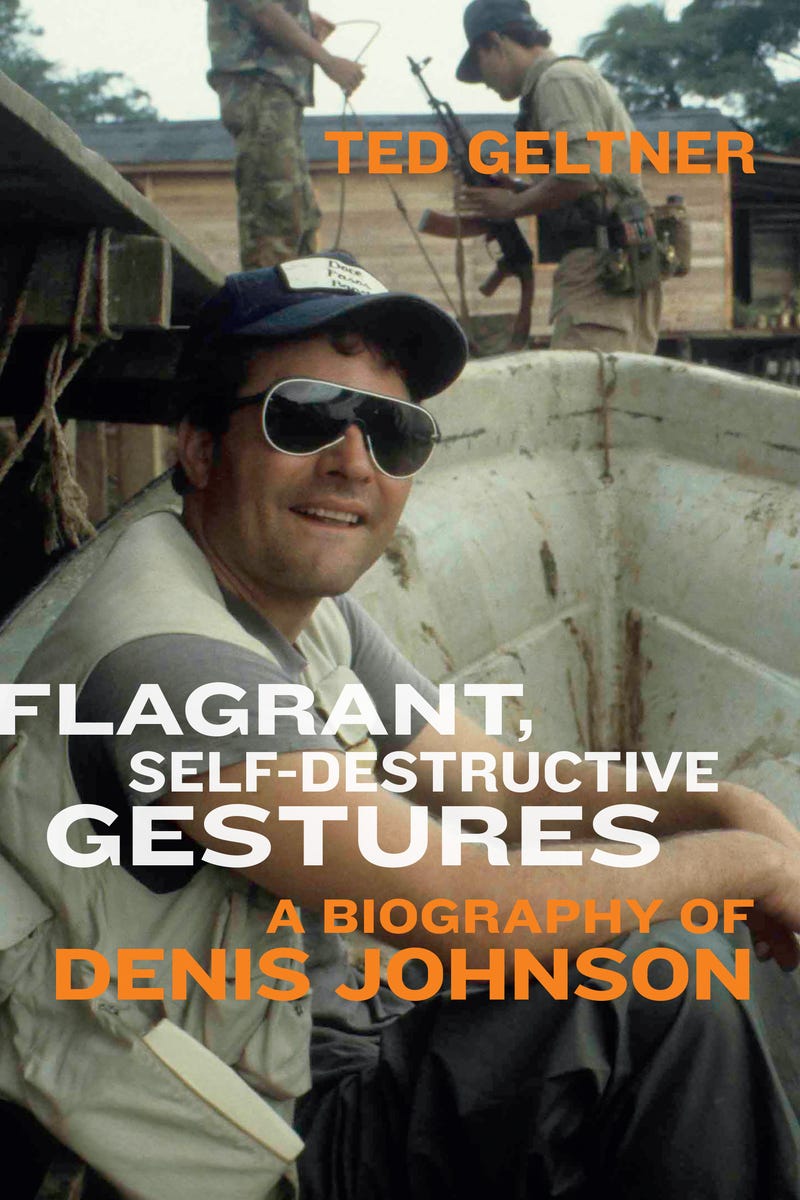
Denis Johnson is having a moment--a posthumous moment, but hey, better late than never. Late last year, Train Dreams, probably his finest work, got the deluxe Netflix treatment. I haven’t seen it yet, but a reputable source tells me it’s excellent. The same month that the film adaptation was released, University of Iowa Press published an entertaining biography of Johnson called Flagrant, Self-Destructive Gestures, by Ted Geltner. In January, I walked past several local bookshops and saw the covers of Johnson’s novels and short story collections on prominent display.
I’ll join the Denis Johnson party by posting a link to an essay he wrote for Salon in 1997. It’s a sharp little piece about the decision to home school his two younger children. Johnson lived, let us say, a wild life. The essay comes from the late, domesticated period of his career. I encourage you to read the whole thing, but this is my favorite passage:
What about friends their own age? The kids have to work at their friendships now, using the phone and mail and arranging visits. They don’t see their comrades every day. Some days they don’t like that, most days they don’t seem bothered. But the question of friendships touches on a larger and vaguer question. Just as people used to ask me how much my Great Dane weighed and how much he ate, people invariably ask about home schooling — “How will the kids be socialized?” When in turn I ask what it means to be socialized the answers vary wildly, but everybody seems to agree that there’s no better way to get it done to you than to be tossed into a kind of semi-prison environment with a whole lot of other persons born the same year you were.
I question that now. After three years learning at home, Daniel and Lana seem sociable in a way I wouldn’t have hoped for. They don’t convey the impression I usually get from kids, and must have given to my own elders, that they’re pretending, wishing — as I certainly did — that grown-ups didn’t exist. They live in the same world we, their parents, live in. They look us in the eye. We’re counted among their friends.
When I asked the kids this morning what they like about home schooling, they said “incredible freedom” and “lots of leisure.” Lana mentioned being able to spend time with me and Cindy. What about the drawbacks? — “Can’t see our friends every day.” “People act like we’re odd.” “They make me feel alienated.” “People always say, ‘So! When are you going back to school?’” This last is something I often notice too — the expectation that every experiment must end.
I don’t want it to. It’s changed all of us, and speaking just for myself, I’d be hard put even to find the language to talk across the gap to the person I was before.
Maybe Johnson’s caricature of modern schooling is too harsh. Growing up, school certainly felt like prison to me. Nowadays, when I look sideways at these institutions, I can’t help but think that they begin to resemble the caricature. Set that aside, though. What really speaks to me is the wish for children to have the space and freedom and pleasure to be children. Some of you probably know that I homeschool our four kids. I do this not because we don’t believe in public education (we do) or feel passionately about school choice (we don’t) but because modern educational institutions, public and private, have drifted so very far from a purpose that might take our kids’ flourishing seriously. It’s not the teachers’ fault, for God’s sake, nor does the blame lie with administrators’. It is decades of underfunding coming home to roost; the greed and rapacity and callousness of our government leaders; the spineless fools who run the tech companies.
Of course, not every family can make the choice that we did, and not every school is like this. I know parents and students who desperately need the services they get at school. Many need more than they currently get. Still, there are others, perhaps like me, who feel ill at the thought of sending my kids somewhere they will grow to hate. Maybe, for us, homeschool is the right choice.
We came to the decision to pull our kids out of school slowly, haltingly, wracked by fear and uncertainty at every step. How could we, faulty parents, be enough? Who would their friends be? Johnson says the secret to homeschooling is willing to fail at what the schools have already failed at. (Another secret: church, a built-in community, helps. It is an imperfect, sloppy, often infuriating community, but church is a place like the farm, a place where my kids belong.) Like Johnson, we’re three years in, and I can’t help but conclude that it was the right decision. My kids are our friends because of it, and I’d like to think I’m a better person. Homeschool has forced me to grow in patience and kindness.
Okay, enough on school. One more question: any of my readers seen the Netflix adaptation of Train Dreams yet? Was it good? Let me know in the comments.