


In our home, the stomach bug arrives with the sort of whimper you might be tempted to tune out. “I’m not hungry,” “my stomach hurts,” “I feel like I have ten babies in my tummy”: over the course of the last month, I have heard my kids say each of these things, but I have heard version of them all before. Reports of gastrointestinal distress are shockingly common among my kids, and I don’t think mine are unique. I used to be a teacher, and I remember students howling at the slightest twinge of bowel discomfort. Maybe they were cries for attention. Or maybe they were just trying to find a way to get out of class; I don’t know. What I do know is that if I had heeded each complaint, I would have gone insane, and so would have the other students. The same is true of being a parent. As distressing as it sounds, sometimes you really do just have to ignore your kids. If you don’t, every belly rumble becomes a cause célèbre. Only when one of them starts vomiting do you see the complaints for what they were: signs of a secret catastrophe that, Trojan-horse style, is about to fuck your household up.
When I am in the presence of a barfing child, and the child is one I’m responsible for, my field of vision narrows and ordinary objects crackle with intensity. I do things that I would never normally do. When it’s over and I look back, I have a hard time knowing why I did what I did.
Once, on a road trip down I-40 to see family in Memphis, my family stopped at a Chik-Fil-A for a quick stretch and some food. (Hey, we rarely eat out, but when you’re on a long trip and your kids are crying in the middle of Tennessee, you have to choose the lesser of evils.) My wife and I ordered, and our kids zig-zagged through tables towards the playpen in the back. The two of us sat down and while we waited, I happened to glance behind me to see our six-year-old emerge from the glass shell that separates the supposedly adult zone of this restaurant from the kid one. He was holding his stomach with a look of panic on his face. A few of the restaurant’s geriatric clientele turned their heads. Thinking he got kicked, I shuffled sideways out of my booth and rose to greet him when suddenly his eyelids drooped and he tipped his head back a little, sort of like a baby bird right before it lifts its head and opens its beak. The two of us were so far from the trash can (so far) that I formed my hands into a little bowl below his mouth and then he puked in them. I stood there for a couple of seconds, watching the vomit drip onto my shoes and my pants, taking it all in. Then, cradling the hot mess in my fingers, I stepped over to the trash cans and what didn’t leak out I let fall from between my two hands. I glanced back and saw his body convulsing with sobs. My wife had her arms around him. He and I made our way to the car, changed our clothes, and waited outside for the rest of the family to join us back at the car.
The six-year-old is now ten. Whenever he tells his Chik-Fil-A vomit story, he recalls my cupped hands stretching out to meet his mouth with something like gratitude.
Our family’s most recent tussle with the stomach bug happened two weeks ago. Mercifully, it wasn’t particularly violent. Instead, the virus passed through each member of our household with a kind of remorseless punctuality. Our youngest got it first. The best that I could tell was that she was playing a card game alone in the hallway of our home, vomited, and went on her way without telling anyone. An older sibling found the mess. Soon everyone was hollering about throw-up on the floor. I rushed from the kitchen to find four kids huddled around a small puddle of watery mush. The youngest fessed up: she told us she was playing and then she just threw up, no big deal, she didn’t doubt that I could clean it up easy. She seemed fine and then threw again an hour later, shortly before the next-youngest, her brother, started complaining that his stomach hurt. He didn’t vomit, mercifully, but everyone else did.
After cleaning up in the hallway, I realized that I, too, felt quite ill. I managed to pull our TV out of the closet and set up a movie for the kids before crawling to my room. I spent the rest of the afternoon hugging a bucket in bed. When I felt a bit better, I went over to my desk and grabbed my laptop. I scanned through our subscriptions to see what I could watch for free. Anything would do, really. For whatever reason I settled on Vertigo [1958], a movie I hadn’t seen since I watched it in high school with friends.
I payed attention as best I could, drifting in and out of the plot. Scottie Ferguson, a police detective played by a seriously old Jimmy Stewart, struggles with bouts of extreme vertigo. He’s forced to retire and take on part-time private work. Soon, he’s hired by a shipping magnate named Gavin Elster. Elster asks him to trail his young wife, Madeleine, a woman who (believe it or not) has been acting strangely--so strangely that she seems to believe she is the reincarnation of her own great-grandmother, Carlotta Valdes, a woman of dubious racial and social background who died thirty years before.
Trailing Madeleine, Scottie soon falls in love with this woman who is at least half his age. But there’s a bigger problem for Scottie: Madeleine isn’t really Elster’s wife. She’s just a shopgirl named Judy that Elster hired off the street to impersonate his wife. With Judy’s help, Elster murders the real Madeleine by shoving her off of the top of a bell tower while Scottie struggles to follow the fake wife up to the top (remember, he’s supposed to have vertigo). While Scottie cowers on the climb, magnate and fake wife get away--somehow, it seems, without passing him on the stairway. Elster has engineered the perfect alibi: his crazy wife simply jumped to her death. After a surreal trial scene in which no one is found guilty, Scottie is committed to the psychiatric ward, and the two co-conspirators, Elster and Judy, return to their normal, separate lives, the former no longer bound to a woman he doesn’t love, the latter returning to her life as a San Francisco shopgirl, just a teensy bit richer.
If you’ve seen this movie before, you know that the murder scheme isn’t revealed until the film is two-thirds over. And if you haven’t, then dear reader, I’m sorry I’ve spoiled things, but you’ve made it a thousand words into an essay about a movie you haven’t seen before, maybe you deserve your disappointment. In any case, for the bulk of the film, we aren’t supposed to know that what we’re seeing is a trick, a ruse, nothing real. When a depressed Scottie is released from the hospital and happens across a shopgirl who looks just like Madeleine, you’re inclined to wonder if this is just a trick of cinematic art. Has Hitchcock ordered the same actress to play this other woman in order to make us think that Scottie isn’t totally insane? Or does he alone--and us along with him--see Madeleine’s face in Judy’s? Only when you see Judy the shopgirl sit down and write out a confession, which is read out loud as voiceover, do you realize that it is the same woman writing the letter, Judy is the fake Madeleine, the fake wife that Scottie already fell in love with.
The rest of the movie feels like a long, inevitable sigh. Scottie spends every minute, every dollar, making Judy over into the image of an image of a woman he once thought he was in love with.
I’m usually a sucker for noir, but this time, it wasn’t the plot that grabbed me. If you strain too hard, you start seeing holes. Here’s one of the most gaping: in the opening scene, Scottie is chasing a criminal across a rooftop. How did he get up there if he already had a fear of heights? Setting aside pothole-sized plot holes, what grabbed my curiosity were the gorgeous images that occupy just about every frame of the film. The version I watched was the 2018 remaster of the original VistaVision negatives. Maybe I was hallucinating under the covers, but I can’t remember a movie I’ve seen that felt quite so visually rich.
The film takes place in San Francisco, and while a number of scenes and panning shots show the skyline and the surrounding Bay area, the camera seems most interested in exploring the textures and colors of urban spaces, often indoors: apartments, a flower shop, a psychiatric ward, offices, a museum, a bookshop, the interiors of cars and clothes. In a number of scenes, it feels like the camera is bored with what the characters are saying and starts caressing the walls, the drapes, the chairs and couches, or the lapping waves of San Francisco Bay.
One of my favorite scenes (and, as I later found out, one of the film’s most famous) arrives early in the movie. It takes place at a restaurant called Ernie’s. Ernie’s, I have read, was a real San Francisco restaurant. Hitchcock was so enamored with the place he had an exact replica of it painstakingly reconstructed on set at his studio at Paramount. According to the film historian, Charles Barr, it took Hitchcock exactly one year to get the Ernie’s sequence, which occupies a whole ten minutes of screen time, filmed exactly the way he wanted.
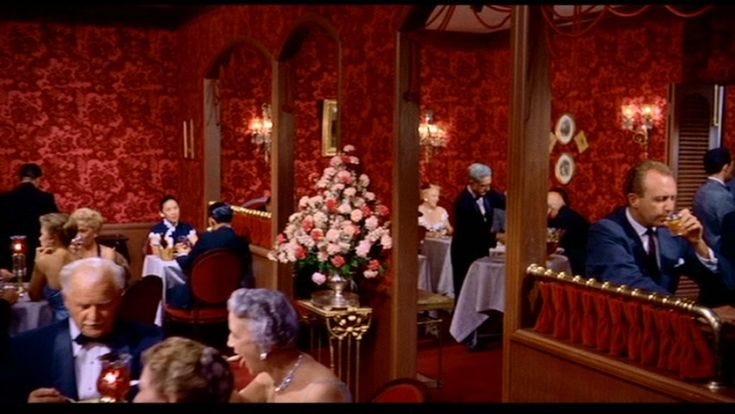
Except for the wainscot and the floor, every square inch of the interior is covered in a thick-looking red-velvet damask. The carpet is all plush and red, too. When I first saw it I thought, oh, this is where the red room in Twin Peaks comes from. But the original red room is full of geriatric people wearing ball gowns and tuxedos while they eat and talk with funereal decorum. Fake Madeleine, you quickly sense, is the only young person in the room. and it’s full of old people eating. There’s plate clatter in the background, which is not surprising, given the age of the diners. But no child, let alone a puking one, in sight.
Scottie, the detective, is seated at the bar, and he is there to get a first look at Madeleine. A minute or so into the scene, the couple gets up and makes their way to the exit. Scottie looks away, pretending not to be watching them, but the camera remains focussed on Madeleine. When she walks, she seems to glide across the floor. The effect has something to do with the volume of her dress--you can’t see her shoes--and the silence of the carpet. As the couple makes their way for the exit, the camera’s viewpoint reunites with Scottie’s, and in a mirror that faces the camera you see the profiles of husband and wife walking arm-in-arm. When they stride across the face of the mirror, two people suddenly double into four, and for a brief moment you watch at four distinct figures converging on an exit that isn’t wide enough to accommodate them.
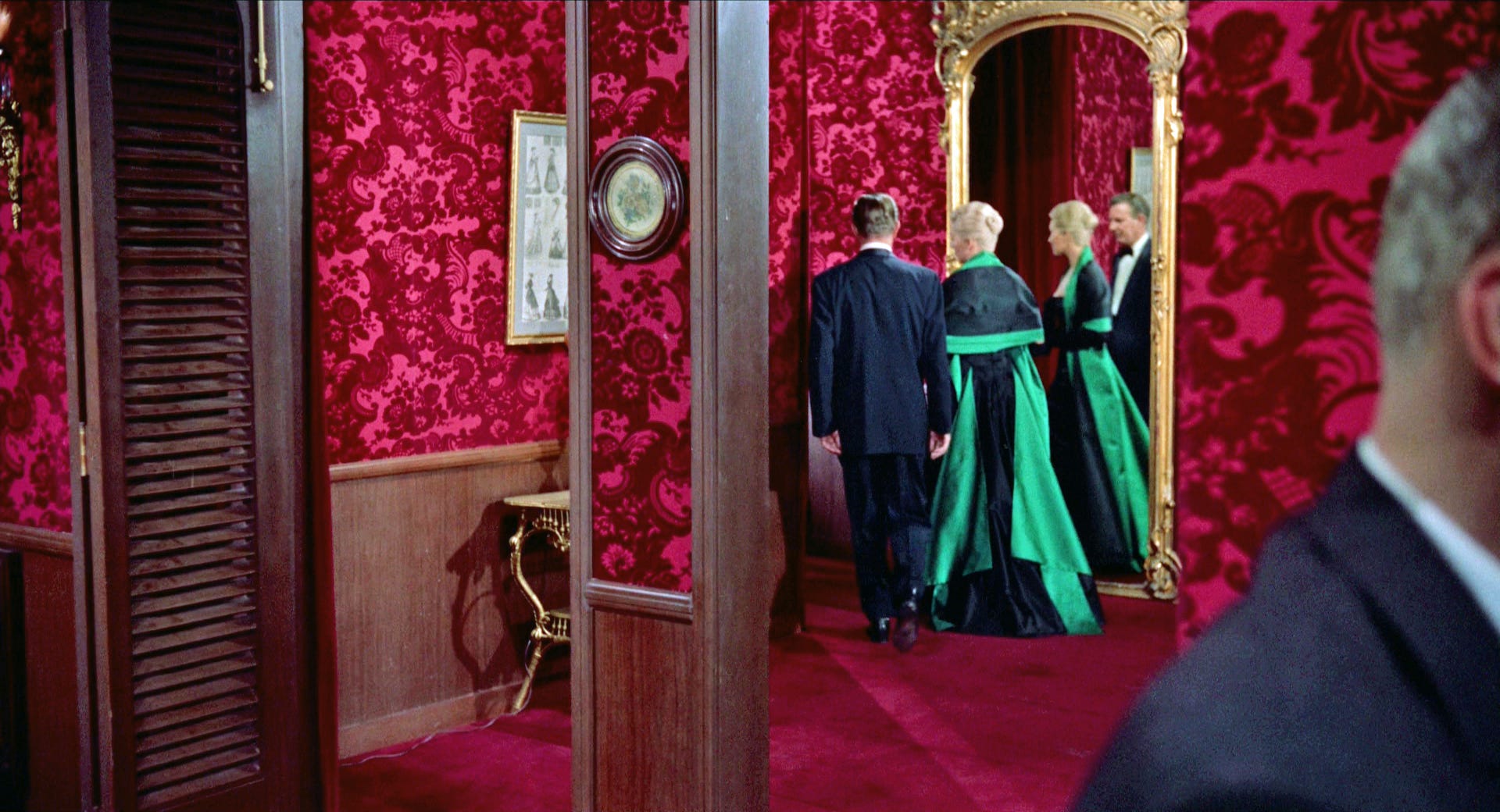
Things are not what they seem, for us or for Scottie. But the scene abruptly ends and the film takes you elsewhere. It is an extraordinary moment of fantasy and furtiveness made possible by the play of opulent, dreamlike surfaces of the restaurant’s interior.
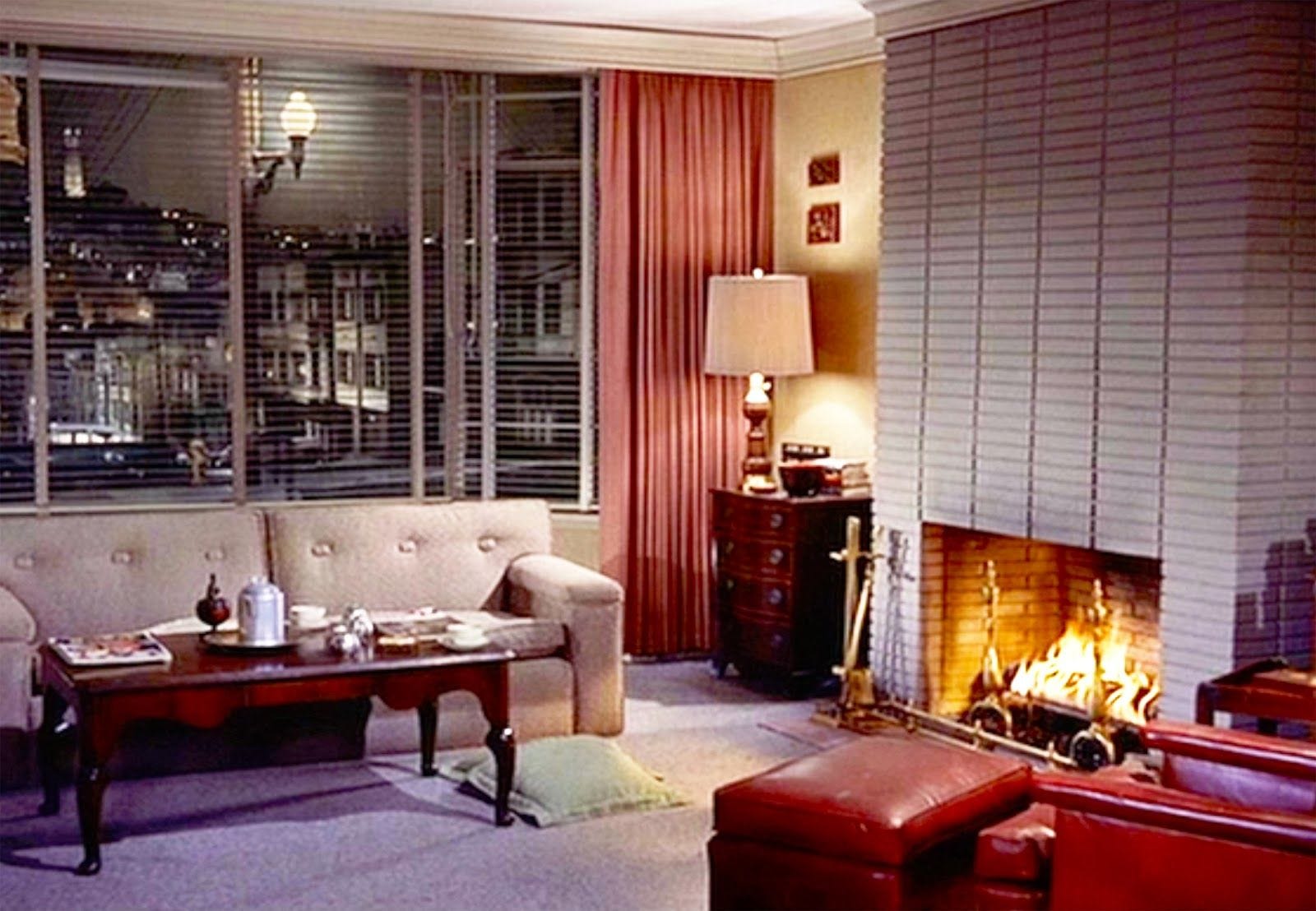
The movie is chock-full of scenes like this. One beautiful shot after another presses against your bearings as a viewer. The ones that really got to me take place in Scottie’s apartment. After Madeleine fake-attempts suicide by chucking herself into the bay, Scottie ferries her apparently unconscious body back to his apartment, undresses her, and lays her down in his own bed. He waits outside in his living room until she wakes up. When she awakens, she dresses in someone else’s nightgown, and the two of them sit in front of the fire in this bachelor’s living room and have an awkward chat. Scottie’s pretense is a kind of anonymous do-gooder care over her mental state. Really, though, Madeleine’s husband has hired him to tail her. But also, there is the attraction, which he doesn’t exactly disguise. Instead, it finds a disturbing place within the whole innocent-passerby ruse. But the film has already made it clear that this attraction, impressed upon us in the Ernie’s scene, is very much real. Somehow, Scottie’s desire is both feigned and felt.
All this visual interplay between image and referent, pretense and real life, takes place inside an apartment that is so distractingly beautiful that it you really want to look away from Scottie’s predator-like fixation on this woman and see how he’s decorated the kitchen. The guy’s living room looks like it belongs in a museum: the couch, the glassware, the horizontal lines of window blinds mirror the painted brick of the fireplace. It is a temple of high modernist interior design.
The outside of Ferguson’s apartment may even be more appealing. I mean: go watch the movie and look at the place. It is a soft-cornered stucco box painted in robin’s-egg blue. The window trim is painted a deeper shade of the same blue, nearly the same sparkling color as the Bay. The bright, red entry door is shielded by a square notch cut out of the corner of the building, which forms the alcove. A steel railing fences the alcove, and it looks like it’s painted with the same red as the door, only the saturation has been taken out. It’s more of a pale, rusty echo of the door. The whole place looks exquisite. Who wouldn’t want to live there? (After snooping around on Google Streetview, I have good and bad news: the same building is still left standing, but the current owners have remade the building over into a gray blob.)
I watched the scene at Ferguson’s apartment and the comings and goings that followed, and I have to confess that, despite the repulsive conduct of its occupant, the house was irresistible to me. For a brief moment (long enough to remember it, anyway) I suddenly felt the attraction of a domestic space like this: a beautiful place away from children, the inevitable piles of clutter, the excretions, the vomit, the juvenile body’s perennially impatient needs. For about a second, I wanted to be somewhere else, somewhere like this building, maybe, inside or outside of it, I didn’t really care, just away from my kids and away from the stomach pain.
The house spoke to me, I suppose, because it disclosed a model of solitary masculine domesticity that is currently unavailable to me, a dad and a spouse, a man who spends many of his waking hours cleaning up messes and caring for children. It reminded me that there are two kinds of space, the one I have, the one for rearing children and seeing to their needs, and the other kind, whose purpose is little more than being nice to live in and look at. One is not inherently better than they other, but they can’t go together or co-exist at the same time. Anyone who has ever had kids or spent time caring for them knows they are incompatible. And the incompatibility ensures that at least one of them sometimes looks appealing from the perspective of the other.
Let me be the first to say that this is a weird thing to get hung up on in a movie. If a random group of Americans watched Vertigo for the first time, I doubt any of them would be captivated in the same way that I was or still am. Then there is the illness. I’m not sure that I would have felt the way I did had I not spent the morning cleaning up barf in my house and then barfing. Another person will watch the same scene and not feel anything but anger. Vertigo belongs to an America that seems neither possible nor desirable, an America that many would happily believe we are long past, especially the film’s representations of gender and of race. However, the fact that the film works so hard to make its fantasies present to the viewer seems more important than the glittering specifics of any scene or site location. The further I get from this first viewing, the clearer the film’s devotion to foregrounding highly stylized, deeply saturated spaces seems to be. As the narrative moves forward in time, the play of surfaces takes on an incantatory quality. The visual play is intended to hypnotize. It’s designed to do the thing that it did to me.
2.
When Vertigo premiered in 1958, critics assailed the film for its profligate visuality. Writing for the New York Post, Arthur Winsten declared that Vertigo was pure “visual confectionary” and “too full of holes” to ever rank among the director’s best. The New Yorker’s resident film buff, John McCarten, fumed that Hitchcock, “who produced and directed the thing, has never before indulged in such far-fetched nonsense.” For most audiences, it was as if Hitchcock had abandoned the thing that mattered most in his movies: the plot. By the 1950’s, Hitchcock’s name had long been synonymous with narrative twists and turns, murderous intrigue, crimes committed and crimes solved. By comparison to what came before, Vertigo seemed negligent to the point of violation. No one in America believed that it deserved to be taken seriously.
Vertigo received a warmer welcome in Europe. The filmmaker Eric Rohmer, writing for the legendary film magazine, Cahiers du Cinema, immediately ranked Vertigo among the finest films he’d ever seen. However, a decade after its release, Hitchcock grew so upset with Vertigo’s Ango-American reception that he pulled the film from distribution and kept it under lock and key until he died.
The film’s fortunes shifted when Universal bought the rights from Hitchcock’s estate and struck new prints from the restored originals. In the mid 90’s, Vertigo started showing up on popular rankings and “best-of” lists, like AFI’s “100 Years...100 Movies.” The film’s reputation underwent such a dramatic reversal that this last, lost relic of the golden age of cinema seemed poised to reveal something about the medium of film itself. What forms of looking and seeing does cinema depend on to work? What kinds of visual pleasure is possible in a film? Scholars and theorists swarmed to the film’s exploration of voyeuristic pleasure. A list of prominent thinkers who wrote about Vertigo in the decade following its restoration reads like a “who’s who” of late-twentieth-century aesthetic theory: Stanley Cavell, Frederic Jameson, William Rothman, Gilles Deleuze, Slavoj Zizek, Jacques Ranciere. It’s hard to name a single film that did more to entrench the discipline of film studies in the modern academy than Hitchcock’s Vertigo.
Curiously, one of the most influential interpretations of Vertigo arrived much earlier than the analyses of the overwhelmingly male group of commentators I just mentioned. In what would become a founding document of feminist film theory, “Visual Pleasure and Narrative Cinema” [1975], Laura Mulvey singled out Vertigo as a prime instances of the way Hollywood subverted female agency by turning women into “sublime objects of desire.” Mulvey coined the cumbersome term “fetishistic scopophilia” to describe the specific techniques Vertigo relied on to articulate the film’s habitually masculine gaze. By having the points of view of Scottie, director, and audience converge on her face or curvy figure at key points in the movie, Vertigo transforms the actress into a glamorous, unattainable feminine signifier. But if “Madeleine” cannot truly be attained by any one man (Scottie, director, audience), then she is ultimately a threat, and Scottie and, by extension, the film, must expose her performance of femaleness as fake.
One of the reasons Mulvey’s essay feels so persuasive is because it helps explain the aura of remorselessness that lingers over the final third of the film. When Scottie finally discovers Judy’s deception, he thinks that he’ll be able to overcome his vertigo by taking her back to the scene of the crime. When they get there, Scottie rages at her until Judy’s spooked by the fluttering gown of a nun, and she jumps. Technically, the killing is accidental, but as soon as Judy’s true identity is revealed, which happens two-thirds of the way through, it’s hard to imagine an ending in which Judy comes out well. The extremity of Scottie’s derangement--and the film’s indulgence of it--seems to demand this outcome.
It’s not just the movie’s female lead that becomes iconic, though. It’s the entirety of San Francisco itself, the lush domestic interiors as well as the most recognizable public spaces. It’s all spun from the same glamorous cloth. Hitchcock’s camera refuses to disclose anything but richest, most saturated, most well known images of the place.
The film scholar, Charles Barr, puts the matter this way. Part of Vertigo’s visual charm has to do with the way that it “draws in, and indulges, the pleasurable gaze with extraordinary fulness.” At the same time, the movie “foregrounds the mechanisms behind [this fulness]” by repeatedly calling attention to the conditions of pleasurable looking. In other words, for Vertigo’s visual charms to work, the film works hard to hide certain images of city by foregrounding others.
Consider the city itself. Vertigo is unique among the films of Hitchcock for being so explicitly rooted in a single location. But what version of the city does the viewer get? Repeatedly in the film, we are shown glimpses of the urban triumph of postwar capitalism. Gavin Elster, titan of San Francisco’s shipping world, whose name somehow echoes the name of California’s hopelessly unctuous governor and presidential hopeful. We see the Redwoods and the burgeoning “eco-tourism” industry. The tacky cross-section of tree trunk with text bubbles that show which ring corresponds to which major historical event (here is when the Battle of Hastings took place; and here is when Columbus discovered America; and here is when the Declaration of Independence is signed). The iconic Golden Gate Bridge and the frothy spume of the Bay beneath. The luxury retail shops. The monuments. The architecture. The snaking, maze-like streets.
What don’t we see? The working class, the dockworker riots, civil rights protest, the city’s systematic suppression of labor organizing before, during, and after the years during which the film was made, people of color, any hint of a reference to the damming of Hetch Hetchy canyon and the infamous water project that made one of the film’s major motifs, the San Francisco skyline, possible in the first place.
Then there is the issue of America’s origins. The film carefully, repeatedly links the violence of capitalism with the violence of the San Francisco’s past, an America not-yet-made. In the scene where Elster and Scottie first meet on screen, Elster talks nostalgically of “Old San Francisco,” as if it were a buddy he knew back when. “This city,” Elster says, “it no longer spells San Francisco.” Then, he gestures to a painting of the city in 1845, and he claims that in those days, a man was free to take what he wanted, to be whatever he wanted to be. Not anymore, according to Elster. Amazingly, in the background, outside the window of an office the size of Scottie’s apartment, hulking cranes slide back and forth above scaffolding on a container ship.
A few scenes later, when Scottie tries to learn the story of Carlotta Valdes, he visits an antiquarian bookseller who talks with an amazing Dutch accent. The bookseller tells him that Carlotta was spurned by her wealthy, white lover (“a rich man, a powerful man”) who absconded with their mixed-race child. Carlotta is reduced to begging on the streets. Eventually, she killed herself. “There are many such stories,” the bookseller concludes. “The men, they could do that in those days. They had the power and the freedom.”
What is this strange nation? Where did it come from? Scenes like these tempt you into thinking that Vertigo is in the business of political legerdemain, of projecting and indulging fantasies of American dominance and plenitude. What’s weird, though, is the way the film constantly draws attention to the idea of projection itself, to the mechanics behind pleasurable looking and feeling. Like Scottie, the viewer is constantly tempted to get caught up in the play of surfaces and not what’s actually happening. It’s hard to find a foothold in this film. But then there these moments where the film reveals itself to merely be a trick of the eyes. At these moments the film’s truth is plainly there in front of you. The truth is that everything has changed, and nothing has changed. Men did terrible things. They still do, and they still get away with them. Without this premise, Vertigo isn’t thinkable. It frames the opening sequence, when an unnamed fugitive escapes the police while Scottie dangles from a high-rise gutter, and it is there at the end, when Scottie, now cured, stares down at Judy’s crumpled body. The difference between the old America and the new is in the pretense, the fantasy, the image, the moving image, the medium of film itself.
A comment from The Dialectic of Enlightenment [1947], published about a decade before Vertigo’s premiere. In a chapter on cinema, Adorno and Horkheimer say that Hollywood tries to integrate its consumers “from above” (96, 107), that is, by projecting the image of capital’s power on the screen before a passive audience of ordinary consumers. Their metaphor is both vertical and horizontal: above the audience is a screen, and the audience gaze at the film from across a room. A film is music, image, word, integrated into a single aesthetic object. The sensory saturation enacts “the triumph of invested capital.” The intended effect? To immobilize the viewer. What could anyone do to stop the movie or stop what’s happening out in the street? The more concretely a film reproduces reality as visual image, they suggest, the more easily it creates the illusion that the world outside the theater (or behind the laptop screen) is a “seamless extension” of what is happening in the film.
In Hitchcock’s film, vertigo is the name for the experience of being unable to move as you perceive the city’s depth, its physical accretions across time and space. Vertigo is what it feels like to look at the world from capital’s perspective when you have no capital. If this is mere coincidence, then it’s the sort of coincidence that joins Scottie’s name and the city that he lives in. They bear the same initials, and if you say them quickly, they almost sound the same. Improbable? Yes. Telling? Yes, too.
Is vertigo what it felt like to witness the triumph of post-war capital? Maybe the name still feels right. But if that’s the case, then what is the name for the feeling when you realize that the triumph has just papered over the rot beneath the surface? Is it nausea?
3.
Friday night is movie night in our household. The selection committee, comprised of four kids and no parents, typically picks something that everyone has seen a dozen times and no one is particularly excited about. By the end of the movie, half the room may be empty. On this particular Friday, my wife, who isn’t the biggest Hitchcock fan, was working late. I realized I needed to bypass the committee. I didn’t let them choose. The movie we’d watch would be Vertigo.
It wasn’t a hard sell. Vertigo isn’t their first Hitchcock. A couple months back, we showed them North by Northwest, which they loved, mostly, except for the interminably long scenes where Cary Grant and Tippi Hedron are making out in a cramped sleeper car. It was so bad some of them had to leave the room.
Vertigo had plenty of cringe for the family, too. Whenever Jimmy Stewart or Kim Novak leaned in for a smooch, the boys, age ten and eight, would scramble off the couch and distract themselves in the hallway. “Why are they in his apartment,” my older daughter asks after Kim Novak falls in the drink. She is totally creeped out by an old Jimmy Stewart. Is this really be the same guy from It’s a Wonderful Life? The girls, aged twelve and three, also got squirmy during the kissing scenes, but they had more tolerance than the boys.
Everyone grew more restless as the movie went on. By the time that Judy struts out of the bathroom with her hair done up like Madeleine, just the way that Scottie likes, my kids had basically stopped paying attention. The problem was the plot. (Isn’t it always?) Twenty minutes into the thing they had pieced together the outline Elster’s scheme without my help. If you happen to know what’s coming, after Scottie’s back in the hospital, the movie just doesn’t feel very exciting. (“The city...it just doesn’t spell San Francisco anymore.”) Does it feel still feel like vertigo when you feel the sensation coming from a mile away? “He’s gone crazy, just like the wife,” my son says. “The guy who did it just got away,” my daughter chimes in, sounding deflated.
At the very end, when Scottie drives Judy back to the scene of the crime, I call them back into the room. The oldest isn’t fooled; she’s never missed a beat.“He must be trying to cure himself,” she says. “Kill himself?” someone asks. Then, as Scottie physically forces Judy up the stairs, I feel the cringe, too. Or maybe it’s nausea. I have made a mistake in showing them this movie. “What’s he doing?” the three-year-old asks. “Why is she so scared?” I hadn’t noticed--had I not remembered?--just how often he puts his hands on her. Am I traumatizing my children? “Yeah, y’all are right, dude’s crazy,” I say, offering clumsy moral censure for behavior that is patently, obviously wrong to my children. I wonder, have my kids heard their parents argue this loudly? Everyone is tuned back into the movie now, except for the three year old, who’s returned to her crayons and paper on the coffee table. “One or both of them is about to die,” the younger son says. The three-year-old looks up. “What are they doing?” she asks.
Then it happens: a fluttering in the dark behind the tower bell, Judy leaps off, the nun steps forward, crosses herself, and after Jimmy Stewart peers out over the ledge, the credits roll. Simultaneously and in unison, my two older kids cackle and howl with laughter. The seven-year-old has a blanket pulled up to his chin; he’s not so sure. The three year old has no clue what’s going on.
I’m astonished. “What’s so funny about the ending?” I ask. “It wasn’t the bad guy up there with them at the end of it all,” my son explains, “just some old lady.” “We both thought Elster would come back kill them both,” my daughter adds. She sighs, throwing the blanket off. She stands up, stretches.
Later, after I’ve put the younger two down, we hear the door click open, and my wife walks in. We hug each other. She turns to the kids. “How was the movie?” she asks.
“Really good. Really, really good,” my daughter answers. “Not my favorite, but the ending was sad and tragic. Which I like.”
Eric Rohmer, French filmmaker, in his 1958 review of Vertigo, wrote the following: “shadows follow shadows, illusions follow illusions, not like the walls that slide away or mirrors that reflect to infinity, but by a kind of movement more worrisome still because it is without a gap or break and possesses both the softness of a circle and the knife edge of a straight line.” The problem of the film, which is the problem of every film because it is the problem of every life, is that fantasy and form travel along the same road of desire. The trick is in learning to see the difference.
Love the juxtaposition of nausea and Vertigo! Raymond Chandler's novels often have that shifting of attention from the plot to the interiors--colors, fabrics, textures, even scents--that and "city as character" seem to be key elements in California noir.