


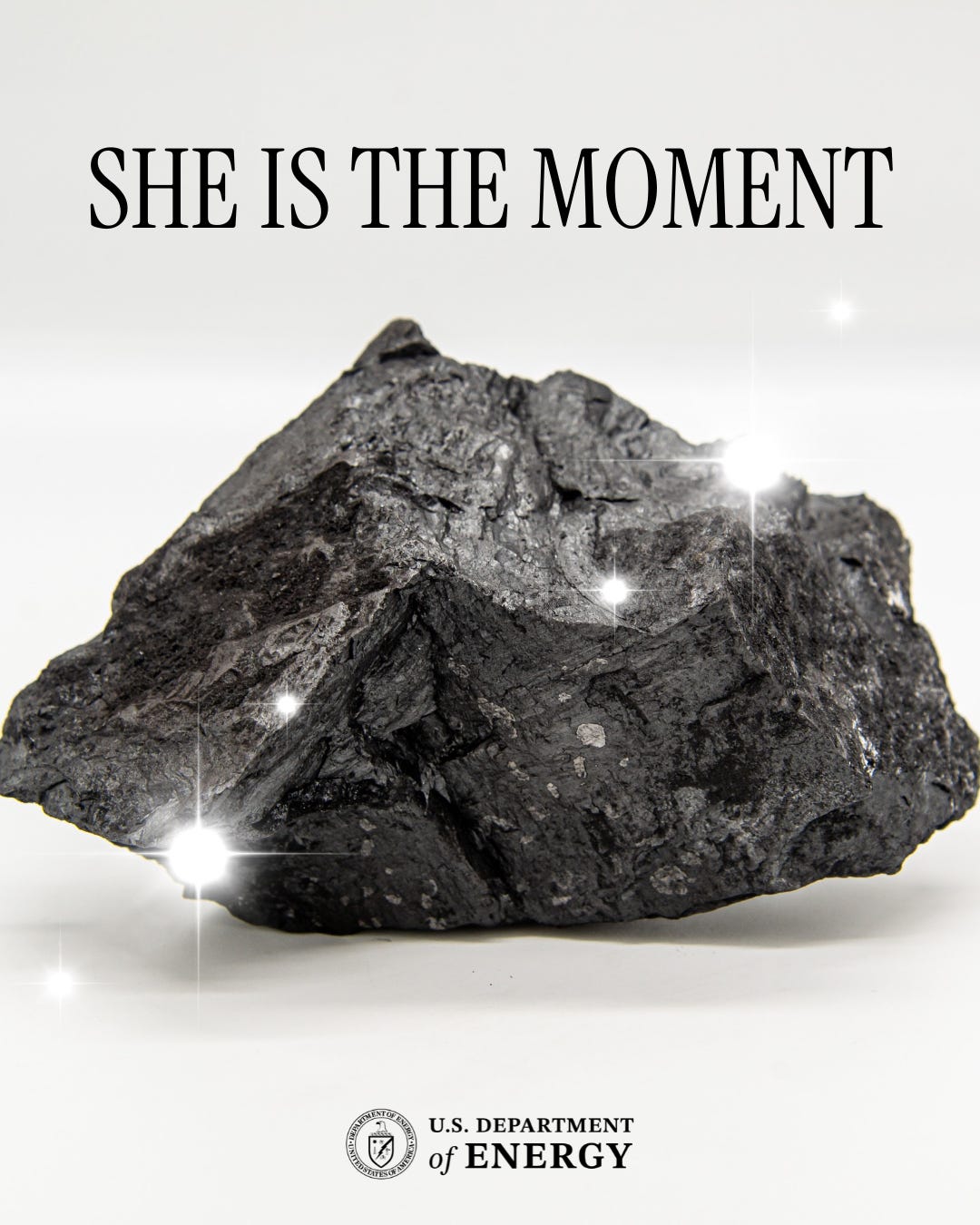
A real image I pulled from a real tweet posted by our very real Department of Energy.
Last week Bill McKibben ran a piece unpacking the implications of Trump’s absurd energy policy. For context: before the election, Trump famously promised executives from the fossil fuel industry that he would ease restrictions on oil, gas, and coal if they helped raise a billion dollars for his campaign. When Trump won, the administration trundled out a cartload of executive orders that, among other things, rolled back regulations on fossil fuels, cancelled clean energy projects on federal land, and abolished the IRA benefits for new clean energy infrastructure–all while increasing subsidies for coal. The reasoning (that was made public, anyway) was that America needs bigger and more reliable energy sources to bring back manufacturing and win the AI arms race with China. As one of the orders from April put it,
Our Nation’s beautiful clean coal resources will be critical to meeting the rise in electricity demand due to the resurgence of domestic manufacturing and the construction of artificial intelligence data processing centers. We must encourage and support our Nation’s coal industry to increase our energy supply, lower electricity costs, stabilize our grid, create high-paying jobs, support burgeoning industries, and assist our allies.
McKibben says this is “nonsense on a cracker.” For one, it now seems plain that Silicon Valley hoodwinked the Trump administration (and we can add to this list most of Congress, as well as a great number of institutions of higher education) with AI hype. A new study out of MIT suggests that 95% of new AI ventures have fallen flat and will have no positive impact on companies’ and non profits’ P and L. In light of such news it seems unlikely that our “beautiful” nation will receive all the data centers we’ve been promised (thank God). But the truly baffling claim here has to do with coal. McKibben points to a new report that argues that keeping coal power plants alive beyond their lifespan will cost American consumers somewhere in the neighborhood of 3 to 6 billion dollars. Electricity prices are already going up for many Americans; they will only go higher under Trump’s plan. According to an NPR report from two weeks ago, electricity prices are increasing twice as fast as the cost of living.
I have learned a lot from McKibben over the years. It’s fair to say that, in the last thirty or so years, no journalist or activist has fought quite so hard and well as he has against the fossil fuel industry. He’s also a Christian, a fact that I have trouble separating from the deep moral clarity with which he writes and speaks. But the man is not without his flaws. On occasion he will suggest that a global green energy transition is destiny, and that Trump and his retrograde cronies are merely delaying the inevitable. It’s true that, on a global scale, the cost of renewables is going down, and steeply. But important research casts doubt on the idea that a green energy future will take hold once the technology becomes cheap and widely available. Consider for example the transition from coal to natural gas and nuclear. In the US in the 1950’s, at the very moment coal ceased being used in households and in industry, its use in production of electricity skyrocketed and remained at very high rates up to the 2000s. As a matter of general rule for the twentieth century, the old forms of energy aren’t discarded so much as they are repackaged, exported, or repurposed in different applications and different settings. The picture muddies even more when you look at energy production on a global scale. The world continues to burn more biomass for fuel than it ever has before. Global consumption of coal in 2020 was 60% higher than in 2000. While coal use in countries like the UK and Europe seems destined to decline, its future is bound up with the very small number of countries that burn 70% of the world’s annual coal supply: China, India, Indonesia, Pakistan, Bangladesh, the Philippines and Vietnam. Adam Tooze frames the matter helpfully (if with syntactical awkwardness): “energy transitions are not so much a general historical phenomenon, or societal regularity, so much as a sectoral and regional particularity dependent on technologies and complex and long-lasting investments in infrastructure.” A global green energy transition isn’t out of the question, but it will require high levels of coordination between large, cumbersome economies and governments whose goals are far from clear. And the dream of that happening of its own accord is (if you’ll again forgive the expression) nonsense on a cracker.
“It seems unlikely that our ‘beautiful’ nation will receive all the data centers we’ve been promised (thank God).” Yes and amen 🙏