


I spent the last week in Colombia—four days in Medellin, a city in the Andean foothills, and three in Cartagena, the southernmost port city of the Caribbean. A friend of mine from back home in Mississippi met and married a woman from Medellin. Twenty or so Americans made the journey south to celebrate. Props to the family back home for keeping watch over the farm while I was away. All seems well.
The wedding and related festivities took up most of our time in Medellin. Except for early morning walks around the neighborhood of Poblado, where we stayed, I didn’t get to see much of the city. I only saw a tiny, hip fragment of a sprawling metropolis of contradiction. Here’s something I learned: Colombia is the world capital of plastic surgery. Walk around the fancy neighborhoods of Medellin, and it really shows. I can’t recall ever seeing crushing poverty so close and cozy to extreme wealth. The place demanded more time and attention than I could give it.
I hate to say that none of us were particularly crazy about the food, which seemed to be a matrix of potato, corn, and meat in different configurations, then deep fried. By day four, I yearned for a different vegetable.
Here is a photo I took from the rooftop of our hotel. The sprawling comunas, the city’s slums, creep up the sides of mountains and sparkle in the darkness.
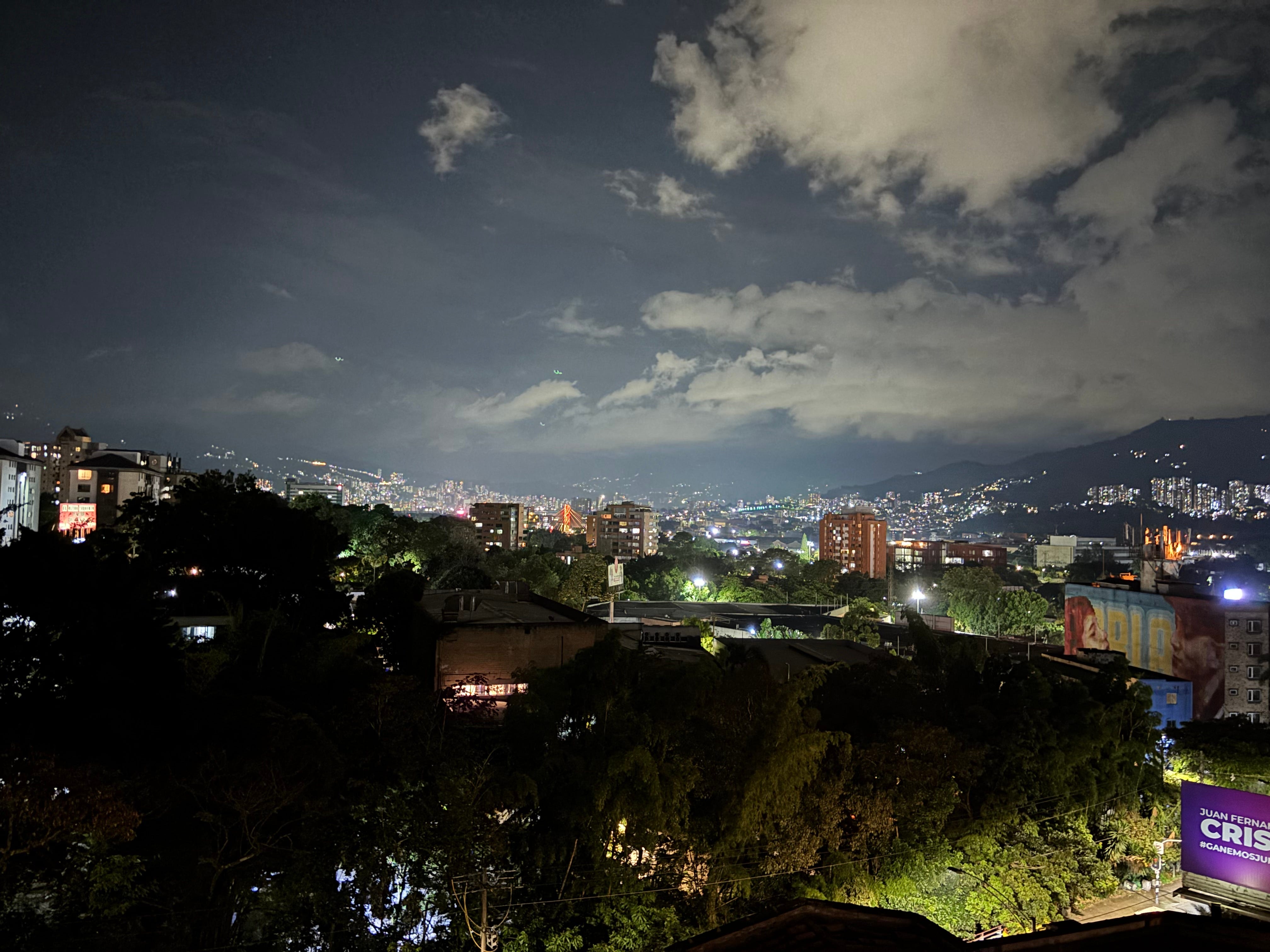
Poblado by night. Photo by the author.
Cartagena is a city of similar extremes. But the old fort town, surrounded by towering walls and rusty cannons that protruded out to sea, felt worlds away from Medellin. Plumes of tropical life erupted in every direction; so many accretions of history visible from the street. Also, the city seemed to ooze. About a month before we got there the old town flooded. The waters had subsided weeks before, but whenever we left the hotel, water would pool along the city blocks for miles. It never rained while we were there, so it was unclear where the water was coming from. But it always seems to have a gentle flow to it.
Cartagena is the city where Gabriel Garcia Marquez lived for long periods of his life. (Love in the Time of Cholera takes place in Cartagena; so does Love and Other Demons.) Once, when I poked my head inside a men’s clothing shop, I saw a framed picture of a haberdasher measuring the outstretched arms of a very old Marquez. Marquez looks confused, like he had just woke up to someone poking him in the shoulder. It was really funny, and part of me wishes I had taken a picture, but it felt weird to snap a photo and then duck away.
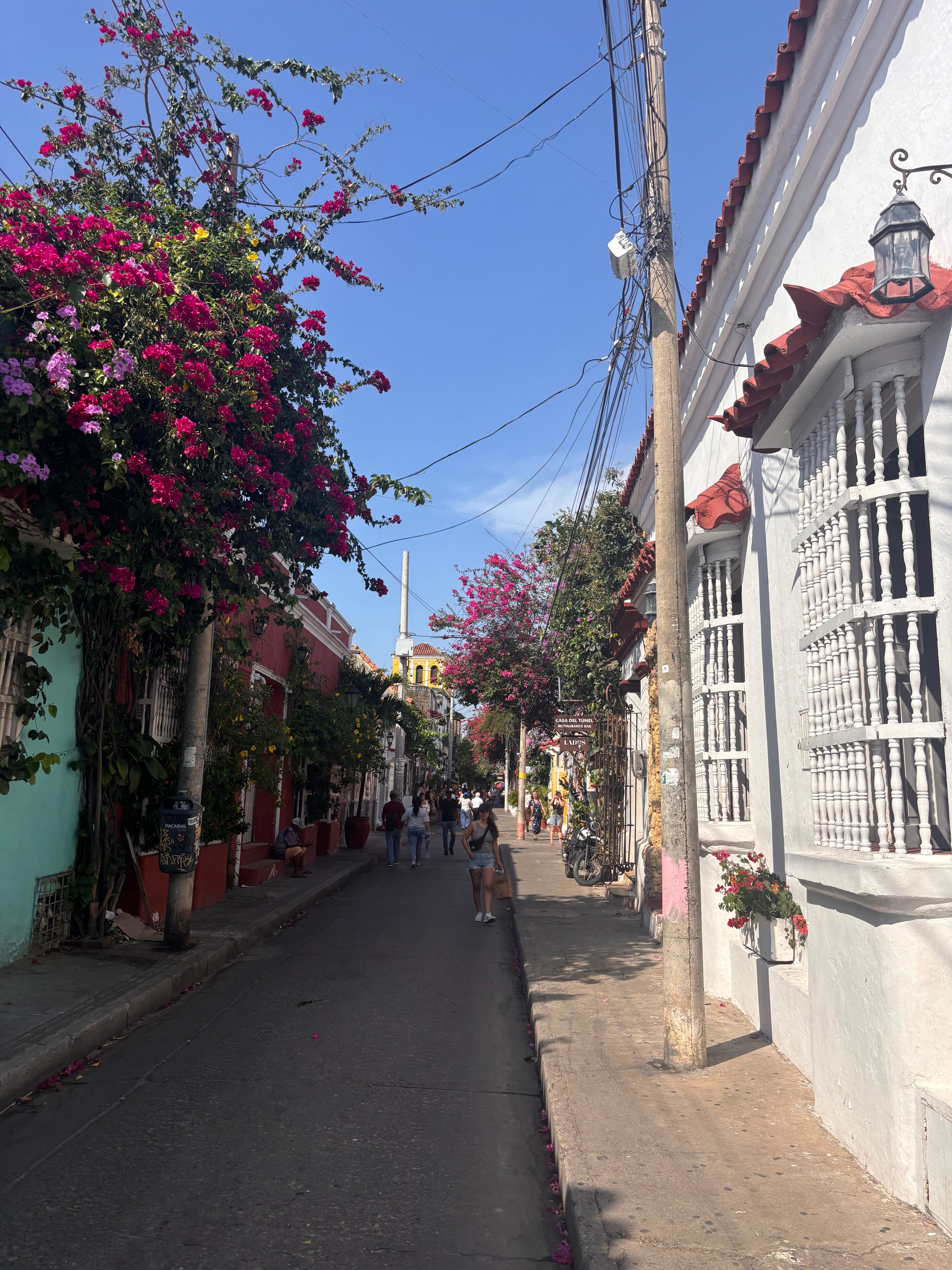
A quieter street in the Getsemani (Gethsemani) neighboorhood of Cartagena (Carthage). Photo by the author.
While we were in Cartagena, a massive international land reform conference took over the big centennial park in the middle of the city. The organization, La Via Campesina, was the focus of the event. If you don’t know about their work, I’d encourage you to read about them. La Via Campesina is an international peasant movement focused on building food sovereignty through agroecology and solidarity. It is, in my view, one of the most inspiring global movements in existence. The conference didn’t really get going until our last 36 hours—we had to leave before the really interesting programs began—but it was enlivening to be surrounded by people from all over the world who believe very deeply in the political possibilities of agriculture and land reform. I am someone who lives in a wealthy country where the concept of land reform is, quite frankly, dead in the water. I felt more hopeful, if only in a vague, unspecified way, about the state of the world than I have in some time.
The world around us lurches towards spring. I have too many writing projects bubbling on the stove. In two weeks, I’ll be buried in farm work. But I press on. In the next few days, I’ll have an essay posted here about a part of a novel that I’ve been thinking about a lot lately: Parade [2024], by Rachel Cusk. More soon.
“ a matrix of potato, corn, and meat in different configurations, then deep fried.” …and that differs from Southern food…how? 😂