


When I used to teach poetry, and it happened to be spring, I would usually find an excuse to have my students read and discuss Gerard Manley Hopkins’s sonnet devoted to this season. I’m sure you know it and have read it before. Often anthologized, “Spring” one of his most enduringly popular poems. Maybe it’s because, for a Hopkins poem, the language isn’t too difficult. The opening declaration, “Nothing is so beautiful as spring,” sounds so simple and intuitive that, whatever “little low heavens” might come after, the reader has good reason to suspect that it might have something to do with the poem’s first-line gambit. Inevitably, though, in our conversations, a student would ask about the “weeds in wheels” in line 2: “when weeds, in wheels, shoot long, and lovely, and lush.” How are weeds like wheels, they’d ask. And I’d point out that the weeds and grasses they were most familiar with were the grasses of suburban lawns, mowed seasonally to near oblivion. Most grasses in urban settings, whether native or not, are kept in a state of perpetually arrested development, never allowed to send up a seed head and seminally reproduce. When grass on rich land grows high, after a heavy rain, it will arc and bend over in thick, cross-cutting bands that, I don’t know, from a certain perspective sometimes look like wheels.
There are worse things in life than not having the right life experience to interpret a line of poetry. Here’s something worse: never having the experience of seeing grass be what it is. It’s as kind of spiritual deprivation, being surrounded by grasses and weeds in one’s life and never knowing what sort of being they express or want to express, all because of the totalitarian uniformity of the suburban lawncare regime.
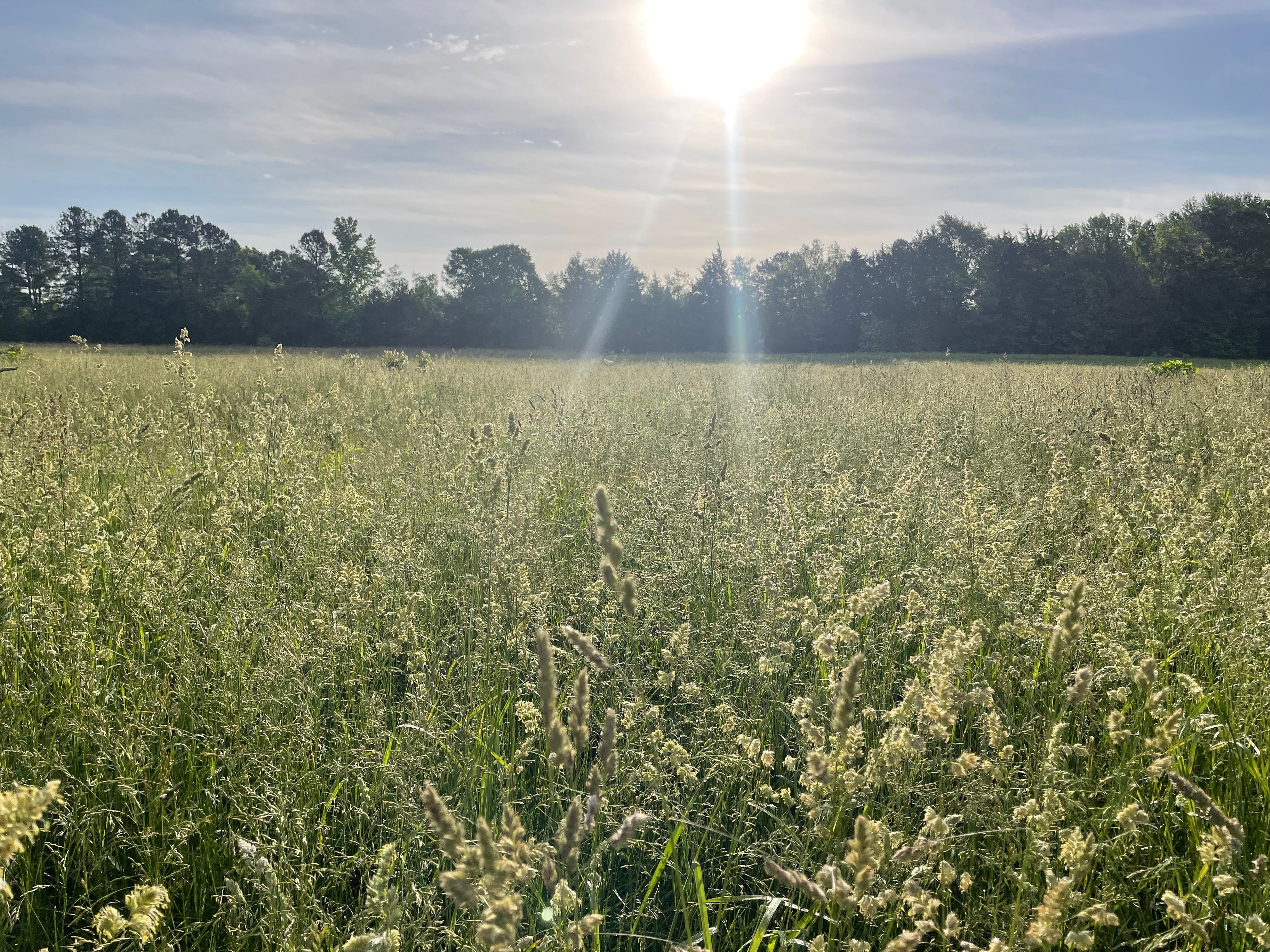
I was reminded of the habituality of these classroom exchanges last week when I had my daughter memorize “Spring” for her school work. I was surprised that she, too, puzzled over this line. Weeds don’t look like wheels, she insisted. After I explained what Hopkins meant, I pointed out that this time of year, the orchardgrass gets so tall that it touches my forehead when I walk through it. It very well swallows her up when she tries. Well, our farm doesn’t look like that right now, she said with truculence now typical. And I realized that she was right: the grass in our fields doesn’t look like that right now, and perhaps won’t for the rest of the year. We’ve missed our window for the “wheels” of weeds phenomenon. We happen to be in the middle of the worst drought in several decades
.
Grass as tall as the author, who does not consider himself short. Photo from 2025 by author.
I’ve been trying to keep it out of my mind for the last few weeks, what drought means, what might happen if it continues much longer. I’ve got hay stores through May, and there’s enough forage on the ground that the cows will be fine until the end of June, at least. But what happens after that? I’d rather not say at this point. My neighbor told me the last time it got this bad, well over twenty years ago, people were selling animals or else shooting them in the field if they couldn’t be sold. All the grass died; soil turned to dust.
Just how bad is it? Looking around at the foliage, perhaps even at your lawns, and you might not realize it. I was talking to two friends who moved here from Texas a year ago, and they said: sure doesn’t look like a drought to Texans. Drive across Falls Lake, though, the source of Durham’s drinking water, and you’ll get some idea of how bad it is. I have to say that part of me doesn’t really want to know how bad it is. When I last looked a month ago, the NOAA said we needed eighteen continuous inches of rain to bring us back up to average annual rainfall for the last six months. Average annual rainfall for our region is 39 inches, give our take. That’s a lot of missing rain, and we haven’t had a drop since I last looked. March and April are typically our wettest months. It’s not uncommon for May and June to be the dry ones.
Hopefully, by the time I write my next post, drought will have been a bad dream.
We have been at the SC house for a few weeks and the drought is here also. The SC Forestry Commission has issued a State Forester's Burning Ban for all counties effective at 7:00 a.m. Friday.
NOAA has recently issued a statement regarding Western PA drought conditions. The Pittsburgh area is improving. Hopefully your area will improve also.