


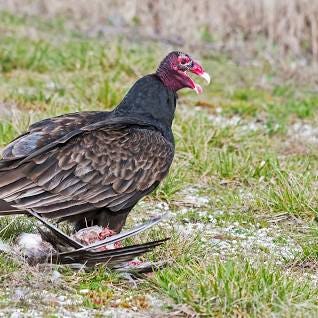
“Turkey Buzzards,” by Paul Muldoon. Last week I visited a friend who lives nearby, and somehow or another we got to talking about turkey buzzards, the big, ominous looking birds that feast almost exclusively on carrion. In our conversation I found myself rattling off a series of facts about them. When I got home, I realized that most of what I said came from Muldoon’s poem, which is a playful and poignant meditation on a bird most of us are used to seeing on roadsides or in ditches, tearing apart the “neon-flashed, X-rated rump/ of fresh roadkill.”
Muldoon’s poem forms a cluster of ballad-like, rhyming quatrains (abab). But don’t be deceived by their apparent simplicity; many readers find Muldoon’s verbal intricacies difficult and sometimes off-putting. The poem rewards patient, slow, ruminative reading. I especially love reciting it aloud. Why not try it? Buzzards don’t have vocal chords, and instead communicate through grunts and hisses. It’s charming to read aloud a beautiful poem about a bird that can’t sing. Wait patiently for the poem’s hook, in which you realize that Muldoon is also, somehow, improbably, speaking about his sister’s experience with cancer.
Fun fact: Paul Muldoon–a poet that the TLS once declared one of “the most significant English-language poets born since the second World War”--was once mistaken for yours truly on the streets of Princeton, New Jersey. Years later, when Wake Forest invited him to campus, I got to tell him the story.
Historiae, Antonella Anedda (NYRB Books, 2023). A new collection and translation of poems by Antonella Anedda, a contemporary Sardinian poet and essayist. The title borrows from the Historiae of Tacitus, historian of the Roman Empire. Anedda’s poems are taught, muscular objects that sift among the entanglements of capitalist empire and middle class European life. They can feel abstract and formal, despite being almost entirely composed in free verse, but then you’ll come across a sparkling detail or metaphor that sheds light on the whole (moonlight “scratching” across the wall of a room, e.g.). Many of the poems have Italian and Sardinian versions; I’m finding the Sardinian is surprisingly impenetrable.
Fossil Capital, Andreas Malm (Verso, 2016). Malm is a Swedish ecologist (a human ecologist, mind you) who writes about climate change and the Industrial Revolution, among other topics. This book charts the global emergence of what he dubs the fossil economy, the self-sustaining economic system we find ourselves in that depends almost exclusively on the combustion of fossil fuels for energy. How did we get here, and how do we get out of it? Malm is not a historian, and the book is very obviously not a work of history. In terms of genre, it reminds me of James C Scott’s Against the Grain: a summa of historical research that’s packaged with a nice, tidy thesis on top. Malm contends that the social relations of capitalism produced the technological innovations around the steam engine and fossil fuel combustion, and not the other way around. If you’re wondering why this is important, the dominant narrative is almost always the reverse of Malm’s claim: the steam engine and associated technologies produced capitalism; capitalism didn’t make the steam engine. Malm’s argument mirrors some claims I’m making in a piece about the history of English agriculture. It’s a fun, engaging read, if you enjoy such things. I’ll have more to say on it later.
Clarence Jordan, The Sermon on the Mount (Koinonia, 1952). Our church has been preaching its way through the Sermon on the Mount, and Goodie’s been returning to this little commentary over and over again. Jordan was a New Testament scholar from Americus, Georgia, who abandoned higher ed in order to start a Christian agrarian community called Koinonia Farm. It was an early, multiracial experiment in Christian socialist living: members worshiped and prayed together; grew their own food; and held all or most possessions in common. (I shouldn’t say it was; Koinonia still exists, if only in a more modest version of its past self). Jordan has a delightfully “aw, shucks” way of communicating the revolutionary nature of Jesus’s teaching in the Gospels. If you’re interested in such things, check out Jordan’s life and work.
Looking forward to hearing what you have to say about the history of English agriculture!