


In 1786, Arthur Young struck up a correspondence with George Washington, erstwhile commander of the Continental Army and future president of the United States. In his first letter, Young gushes. He says that he decided to write Washington because he was moved by “the spectacle of a great commander retiring in the manner you have done from the head of a victorious army to the amusements of agriculture.”1 Young, by now the chief apologist of enclosure and agricultural improvement in Britain, offered to assist Washington in whatever way he could–“men, cattle, tools, seed, or anything else that may add to [his] rural amusement.” In August, Washington wrote back from his farm at Mount Vernon, which he had returned to in 1784 after resigning from his post as the commander of the Continental Army. As Washington explains, he had been away from his estate for eight and a half years. Despite the prolonged absence, agriculture, he told Young in his letter back, “has ever been amongst the most favourite amusements of my life” (6). Now, finally, after nearly nine years away from the farm, he was returning to his first and perhaps greatest passion.
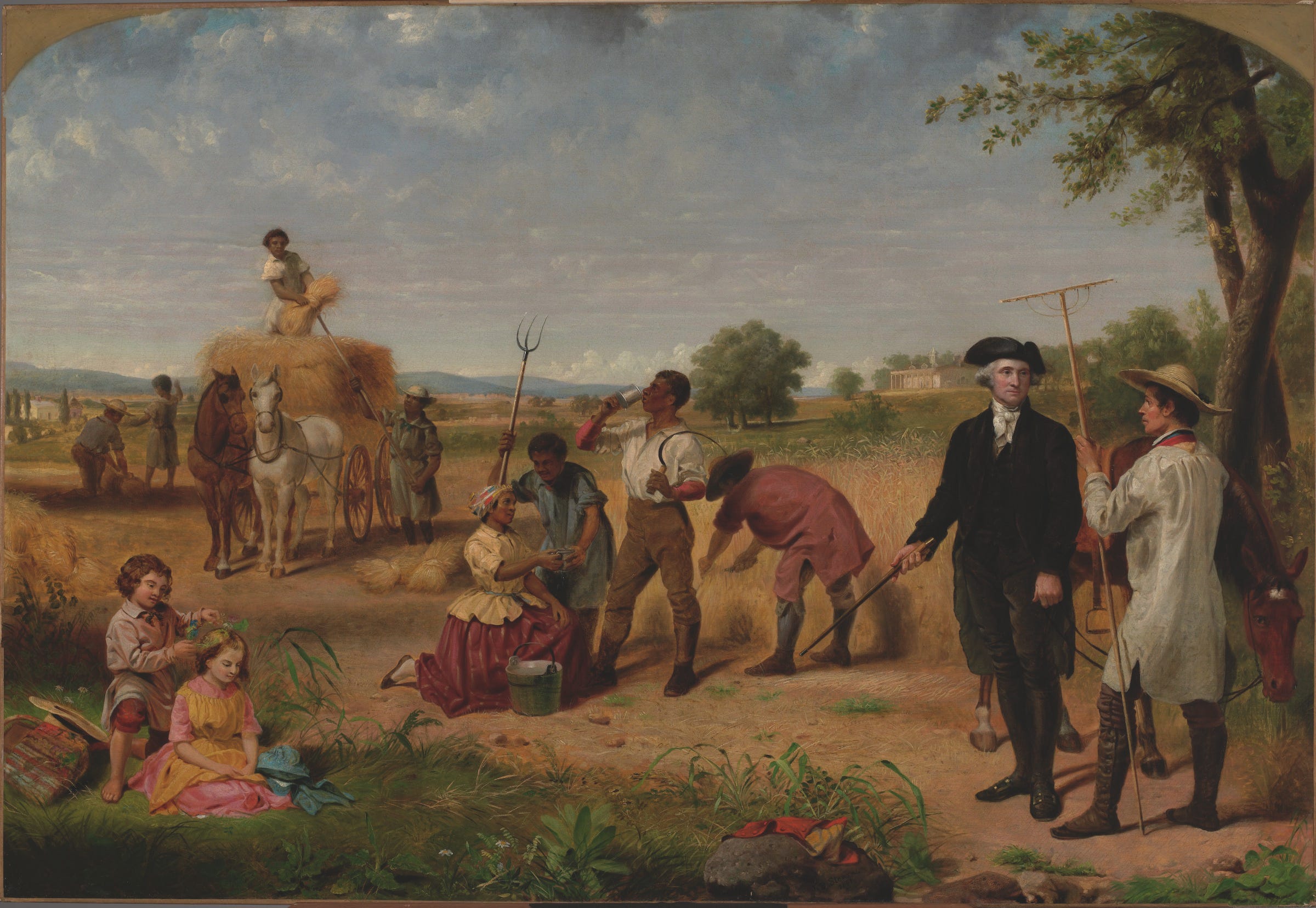
George Washington as a Farmer at Mount Vernon (1851), Junius Brutus Stearns (1810-1885), oil on canvas, Virginia Museum of Fine Art.
Before the war, when he first took over the estate of Mount Vernon in the early 1760’s, Washington amassed a collection of books on methods of agricultural improvement: Jethro Tull’s Horse Hoeing Husbandry (1731); Lisle’s Observation in Husbandry [1757]; Batty Langley’s New Principles of Gardening [1728], six volumes of Museum Rusticum [1769]; and Duhamel du Monceau’s Practical Treatise of Husbandry [1750].2 In 1765, Washington oversaw the conversion of the farm’s arable land (over one thousand acres) from the cultivation of tobacco to wheat. With tobacco prices depressed in the middle of the century, Washington, with Horse Hoeing Husbandry as his guide, conducted a series of experiments in the 1760’s in how to grow other cash crops. Relying on the careful deployment of the labor of the hundred or so slaves that lived at Mount Vernon, Washington began rotating crops (wheat, then corn, then fallow) and amending soils with substances like marl and river muck. In 1765, Washington pivoted and grew no tobacco at all on his main estate at Mount Vernon, relying instead on the cultivation of wheat. His slaves reconfigured the buildings at Mount Vernon estate to hold grain instead of tobacco.
Wheat, Washington thought, would free the colonies from dependence on distant markets of the empire across the Atlantic. Everyone needed flour, and unlike tobacco, wheat need not be shipped across the Atlantic to find a large enough market for it. Above all, Washington thought, the colonies needed a steady supply of domestic grain to support the nation’s growing population. Wheat represented independence; it stood for prosperity. As the historian Bruce Ragsdale recently explained, Washington fantasized about creating an autonomous agricultural district stretching from “the transmontane west via the Potomac to the Chesapeake.” For Washington, agriculture–modelled on the British system–combined private interest and public good. In enriching himself and his lands, he would open up pathways towards the enrichment of this new nation and its population.
Over time, however, Washington became disenchanted with the transformation of his farm. The Tullian model seemed not to make much agronomic or economic sense. Since before the war began, Mount Vernon had run a deficit every year. It would continue to do so until 1787. Most depressing of all were the declining crop yields he observed from season to season. After obtaining the first four volumes of Annals of Agriculture, Washington concluded that his farm had fundamental problems in soil fertility. He told Young that “the system of agriculture (if the epithet of system can be applied to it,) which is in use in this part of the United States, is as unproductive to the practitioners as it is ruinous to the land-holders” (6). Pulling continuous yields of wheat and “Indian corn” or maize–what Washington described as a “great exhauster” (48) of the soil–destroyed the land’s ability to sustain future crops. A year of fallow wasn’t enough to replace the crops you took from the soil the previous year. Nearly two decades later, then, Washington found himself turning again to the latest advice in British agricultural management. At this point in his career as an agriculturalist, Washington was all too eager to connect with Young.
For eight years, from 1786 to 1794, Washington and Young sent letters back and forth across the Atlantic. Washington requested the latest and best seeds and tools; Arthur Young obliged. Washington posed specific questions about method and management of farms; Young dispensed with as much advice as Washington could take. Soon, Washington reached out to his contacts in the colonies to find a farm manager schooled in the latest modes of British husbandry–someone who knew “how to plough—to sow—to mow—to hedge—to Ditch & above all, Midas like, one who can convert every thing he touches into manure, as the first transmutation towards Gold: in a word one who can bring worn out & gullied Lands into good tilth in the shortest time” (90).
At one point in the correspondence, Washington finds himself quite taken with Young’s description of the Holkham estate belonging to William Coke–the same Holkham I examined in my previous post. Young had written that the buildings around Holkham’s manor house serve as “ornaments” to the surrounding agricultural landscape. To see the “new-built farm-houses, with barns and offices, substantially of brick and tile,” one can only conclude that “we approach the residence of a man, who feels for others as well as for himself.” Inspired by Young’s account of the grounds, Washington wants to construct a barn in imitation of Coke’s. Washington solicits input from Young; Young provides detailed commentary. When the structure was completed, Washington boasted that it was “the largest and most convenient [barn] in this Country” (ibid.). A threshing floor–”large enough for three laborers [slaves] to clean the wheat of a five-hundred acre farm over the winter months”--was located in the middle of it. On the outside stood “a great door [that] allowed the entrance of wagons” (ibid.).
Throughout their correspondence, Young and Washington both take great pains to clarify what the problem with American agriculture is. Like Washington himself prior to his conversion to the seemingly alchemical properties of dung, American farmers neglected the incorporation of animal agriculture in the cultivation of annual cash crops. Manure, Young insisted, was the key to soil fertility and profitability. Without dung, there can be no long term fertility or viability. Instead of gathering animal manure and spreading it over arable fields, American farmers (in the words of Washington himself)
If they can be so called [farmers], cultivate much ground for little profit, because land is cheap, and labour is high; but you will remember that when I informed you of this fact, I reprobated, at the same time, both the practice and principle. The history, however, of it is this–a piece of land is cut down, and kept under constant cultivation, first in tobacco, and then in Indian corn (two very exhausting plants), until it will yield scarcely anything–a second piece is cleared, and treated in the same manner; then a third, and so on, until probably, there is but little more to clear. When this happens the owner finds himself reduced to the choice of one of three things—either to recover the land which he has ruined, to accomplish which, he has perhaps neither the skill, the industry, nor the means–or to retire beyond the mountains–or to substitute quantity for quality, in order to raise something (53).
Washington is describing both the history and logic of colonial expansion that drove farmers of “the tobacco states” (ibid.) continuously westward into indigenous territory. At the same time, it’s not a stretch to say that he is also describing his own practice of acquiring vast swathes of lands to the west–tens of thousands of acres–and trying to lease them out to new tenant farmers who don’t have land or had exhausted what they have. Whether or not he acknowledges his own participation in this history, the pattern is the same: colonists cut down timber, clear the land, and keep it “under constant cultivation” until all fertility expired. If they didn’t pick up and move west, they would try to recover the land as best they could. But improvement is an impossibility at this point, Washington says, owing to the ignorance surrounding methods and management. Lastly, if farmers had the capital, they might acquire as much land as possible around them and settle for “quantity over quality” of land.
According to Washington, the problems facing American farms were the obverse of those in Great Britain. In England and Scotland particularly, centuries of enclosure contributed to the formation of a cheap and reliable source of rural labor power. Peasants no longer had their own fields and cottage gardens to tend. Instead, they were forced to labor at the mercy of large farmers. And because arable land was in short supply, it cost farmers a lot to rent it. Thus, if yields could be increased through improvement, farmers had every incentive to mend the land and not the wages of their workers. By contrast, America had plenty of land but hardly anyone to work it. What incentive to improvement would a farmer have if he could just pick up and move westward, or simply buy out his neighbors’ farms? Washington explains:
an English farmer must entertain a contemptible opinion of our husbandry, or a horrid idea of our lands, when he shall be informed that not more than eight or 10 bushels of wheat is the yield of an acre; but this low produce may be ascribed, and principally, too, to a cause [...] namely, that the aim of the farmers in this country, (if they can be called farmers) is, not to make the most they can from the land, which is, nor has been cheap, but he most of the labour, which is dear; the consequence of which has been, much ground has been scratched over and none cultivated or improved as it ought to have been: whereas a farmer in England, where land is dear, and labour cheap, finds it his interest to improve and cultivate highly, that he may reap large crops from a small quantity of ground. (22)
The eight-year correspondence between Young and Washington forms one node in a network of dissemination of British agricultural ideas to America from the 1780s to 1848. This network was composed of a small but vocal minority of American farmers, most of whom were based in New England. They embraced the latest, manure-centered methods of British agriculture and argued on behalf of their adoption in the former colonies. As Steven Stoll argues in Larding the Lean Earth: Soil and Society in Nineteenth-Century America (2002), while they were small in number, improving farmers in America established norms for thinking about sustainability, conservation, and the aesthetics of rural life in the latter half of the nineteenth-century. For improvers, “the richness of well-managed tilth became a standard against which civilization in the US could be judged.” “during the period of its brief ascent,” Stoll argues, “[American] improvement stood in opposition to the most astonishing period of Indian dispossession and white settlement yet seen in North America” (30, 48).
One of the reasons improvement was so attractive to American farmers was that it seemed to offer farmers “ecological stability in a capitalist mode of production.” Instead of chasing fertility from one farm to the next, farmers could remain in place and increase yields and boost their bottom line–that was the theory, at least. Without improving soil fertility, the reasoning went, there could be no economic progress in the country. And without economic progress, the young country could never sustain a democracy. By the early 1800’s, apologists of improvement worried that the degradation of soils along the Eastern seaboard was so bad that “the old states” could never sustain the population that was badly needed for the growth of industry. Jesse Buell [1778-1839], a New York editor and agriculturalist, explained: “our policy has been, by the prodigal management of our public domain, to set in motion a constant current of emigration, which has not only carried off from the sea-board, all accessions of labor and capital from Europe, but which has drained the old states of their most active and vigorous population,” (23). The soil is squandered, and with it go all the “labor and capital” that flow from Europe to the former colonies.
According to the American improvers, the only alternative was to turn the farmer’s attention back to the animals on his farm. John Sinclair, a British agriculturalist and contemporary of Young, put it this way. Cattle are “machines, for converting herbage, and other food for animals, into money.” (56). Buell articulated the same principle on a more concrete scale: “cattle and sheep make manure,--manure makes grain, grass and roots–these in return, feed the family, and make meat, milk and wool;--and meat, milk and wool are virtually money, the great object of the farmer’s ambition, and the reward of his labors” (51). Manure equals fertility equals money. However, the simplicity of these formulae belie the fact that this was a radically interventionist approach to growing food. Rather than waiting on nature to take care of itself, farmers were exhorted to step in and harness the potency of their animals’ dung. Monitor your animals, collect their manure, distribute it across your arable land, and soon your soil would make you rich.
If the economy of the young nation were to grow, the country needed to turn its attention to the soil. As Richard Peters put it, “soil is the basis of national wealth, and its cultivation the only permanent source from which its prosperity can be derived” (47). Peters was a member of the Continental Congress, friend of George Washington (one of his letters is appended to Washington’s own and sent to Arthur Young), and the second president of the Philadelphia Society for the Improvement of Agriculture from 1805 to1818. Here he is insisting that soil is“the only permanent source” of wealth. He sounds like a physiocrat or a classical economist like Adam Smith or David Ricardo. The difference is that, unlike Ricardo (whom Marx ridiculed for his outdated views on agriculture), the permanence of fertility is totally upon the farmer’s correct management of the soil.3 Fertility is no longer a permanent feature of “good land.” For the improvers, animals needed to become the “nexus” of a farm’s activities. Otherwise, a farmer’s arable land–and therefore the country itself–would eventually fall into ruin.
But it wasn’t just the threat of a soil crisis or the promise of future wealth that moved farmers to try their hand at improvement. Promises of future plenty were persuasive, but images of “cattle and rich grasses” in England also pushed farmers to replicate the methods and systems of their British counterparts. “The American tutorial conducted by British authors should not be underestimated in its importance,” Stoll writes, “for the image of rural England–sod green and garden damp–deeply affected admirers in North America,” (57). No one did more to perpetuate these images in America than Arthur Young himself: “Young showed [American farmers] a grassy, burgeoning, and patrician rural life, which remained in the imagination of educated farmers from Washington’s time to [Frederick Law] Olmsted’s” (58). Young’s apologetic turned England’s luminous sod into a symbol of American aspiration.
In America, the core methods of British improvement never caught on in a lasting or substantial way. In the tobacco and cotton producing regions of the South, farmers found little incentive to spend more capital on labor, especially when large farms and small slave populations could generate handsome profits. For many, the temptation of unspoilt indigenous land further west in Alabama and then Louisiana proved insurmountable. However, by the 1850s, agriculture in the Northeast–and indeed the whole nation–had also undergone a transformation of a different sort.
The discovery of massive deposits of guano on the Peruvian coast upended the ecology of American agriculture and set off an international race to claim as many Pacific territories as the American (or British, or Spanish, or French) empire could find. Harvested by Chinese bondsmen (the infamous “coolie” trade) working in unimaginable conditions, guano had soared in global popularity following the publication of Elements of Agricultural Chemistry: In a Course of Lectures for the Board of Agriculture Delivered between 1802 and 1812 by Humphry Davy [1778-1829], the experimental chemist, Romantic, and close friend of Samuel Taylor Coleridge. Davy’s analysis of samples of guano concluded that the foreign substance was far more potent than cow dung, easier to spread on the land, and the deposits along the Humboldt Current in the Pacific appeared to be inexhaustible (the current was later named for the German polymath Alexander van Humboldt [1769-1859], the first European to “discover” it–it had long been sacred to many of the indigenous peoples who inhabited this region).4 By 1850, guano was the preferred remedy to soil infertility for most farmers in Britain, Europe, and America. The historian Gregory Cushman writes that, by 1871, Peru had exported 12.7 metric tons of the substance to Europe, America, and the Caribbean. Guano–paired with the invention of the McCormick reaper (sold commercially beginning in 1840)--did more to make modern agriculture than anything else. Together, they provided a solution to the two great problems that plagued American agriculture: rapidly declining soil fertility and costly labor. In doing so, however, they yoked the production of food to global supply chains and the massive infusion of external inputs that dominate modern agriculture to this day.
***
Stoll suggests–ever so slightly–that for a brief moment it was possible for the nation to go down a very different path. If American farmers had heeded the cry of improvers, the nation might have slowed the ruination of its soils or the genocide of indigenous peoples who lived to the west. Perhaps this is true, but it runs the risk of obscuring the intractable problem of scale that agrarian improvement bequeathed to its practitioners. I mean “scale” in all its senses: the immense quantity of capital needed to initiate the system; the vast quantity of laborers; the acreage of arable land; the scale by which the aesthetics of the land itself was measured and judged and yearned for. Washington is a prime example for illustrating this problem.
Although Washington was hardly fond of the peculiar institution, he, like Thomas Jefferson, came to view slavery as essential to the success of his improvements. Without slaves, Washington simply could not make his farm profitable. He came to rely on increasingly detailed surveys of what each slave did each day and what they accomplished. The historian Justin Roberts points out that, throughout his halting career as an agriculturalist, Washington required “meticulous weekly statistics” regarding every one of the several hundred slaves that he owned. So attentive was he to what they were doing each day that, when his overseer accidentally omitted a name, it was not unusual for Washington to ask for specific details about what that particular slave had been doing and why (“what has Frank, Hercules and Cyrus been employed in? [...] No mention is made of any work performed by them in the Gardeners or other Reports”). Washington devised a sophisticated system to quantify abstract units of slave labor, and he also developed a variation on double-entry bookkeeping to track whether or not those units were being employed profitably. Both innovations, Roberts argues, “drew heavily on contemporary accounting theory”. Roberts’s description of the system makes Washington sound like a forerunner of the scientific management of labor later developed by Frederick Winslow Taylor (1856-1915):
“Washington required that his managers use a system of debiting and crediting his labor account in the farm reports. The total labor pool appeared as a credit above each farm or group of skilled slaves (such as gardeners), and the tasks done by slaves, as well as their sicknesses, pregnancies, or absence, were recorded as debits to that account. [...] From timing his slaves to tracking missing individuals in meticulously detailed work logs, Washington was improving his estate by ensuring that no time was lost” (68).5
I want to end this essay by returning to something that Thoreau wrote in Walden sometime between 1845 and 1854. If you remember my little essay from a few months ago on growing beans, Thoreau had refused to amend his crop with manure, marl, ash, guano or anything else he might have had to import from off of his land. He had done so in spite of the gentlemanly farmer passing by his fields. The man had implored Thoreau to do something to the two and a half acres of poor soil he tilled up. I suggested that Thoreau’s bizarre form of agrarian ascesis was a response to the feverish, colonizing impulses of nineteenth-century American political economy. The problem with America, Thoreau suggests, is that it cannot do anything without expecting something in return. The soil, through centuries of despoliation, has lost its character as gift: “by avarice and selfishness, and a grovelling habit, from which none of us is free, of regarding the soil as property, or the means of acquiring property chiefly, the landscape is deformed, husbandry is degraded with us, and the farmer leads the meanest of lives” (134). Our problem, the problem of America, the problem from which none of us is free (there is no reason to doubt that the author includes himself)–is that we cannot see the land as our kin, as the same stuff that human beings are made of. Its destiny is no longer bound to our own or the destiny of other species. It is merely the means of making us rich. Then, he writes this:
The ear of wheat, (in Latin spica, obsoletely speca, from spe, hope,) should not be the only hope of the husbandman; its kernel or grain (granum, from gerendo, bearing,) is not all that it bears. How, then, can our harvest fail? Shall I not rejoice also at the abundance of the weeds whose seeds are the granary of the birds? [...] The true husbandman will cease from anxiety, as the squirrels manifest no concern whether the wood will bear chestnuts this year or not, and finish his labor with every day, relinquishing all claim to the produce of his fields, and sacrificing not only his first, but his last fruits also.
The number of biblical allusions buzzing around this passage is remarkable. I’d like to mention a few of them. Matthew 6:25-7: “therefore I tell you, do not worry about your life, what you will eat or drink; or about your body, what you will wear. Is not life more than food, and the body more than clothes? Look at the birds of the air; they do not sow or reap or store away in barns, and yet your heavenly Father feeds them. Are you not much more valuable than they?” Then there is the parable of the sower, Matthew 13, which I won’t quote in its entirety here. Then there is St. Paul, with what may be Thoreau’s favorite passage in all of Christian Scripture: “he that ploweth should plow in hope” (1 Corinthians 9:10). In the same letter, St. Paul describes Jesus as the “firstfruits of those who have fallen asleep” (15:20). James 1:16: “by his choice, he gave us birth by the word of truth so that we would be a kind of firstfruits of his creatures.” There is Leviticus, too, which outlines what the Israelites are supposed to do with first and last fruits: “celebrate the Festival of Harvest with the first fruits of the crops you sow in your field. Celebrate the Festival of Ingathering at the end of the year, when you gather in your crops from the field,” (Leviticus 23:16).
But there is one verse that is particularly apposite to the model of agrarian resistance that Thoreau is exploring in his bean field. “I say unto you,” Jesus declares in the gospel of Luke, “that even so there shall be joy in heaven over one sinner that repenteth, [more] than over ninety and nine righteous persons, who need no repentance” (Luke 15:7). One sinner, one grain, one farmer, one field, one day: are these not places to begin from, again and again, with joy?
Letters from His Excellency George Washington, to Arthur Young, esq., F.R.S., and Sir John Sinclair, Bart., M.P. : Containing an account of his husbandry, with his opinions on various questions in agriculture; and many particulars of the rural economy of the United States (Alexandria, VA, 1803).
Washington at the Plow: The Founding Farmer and the Question of Slavery (Harvard, 2021) 30.
For an example of such claims, see Ricardo, Principles of Political Economy and Taxation (Cambridge: Cambridge University Press, 1951), 67. For Marx’s critique of Ricardo’s theory of differential rent, see Capital, Vol. 1, ch. 15.
Guano and the Opening of the Pacific World (Cambridge University Press, 2013), 29.
Slavery and the Enlightenment in the British Atlantic, 1750-1807 (Cambridge University Press, 2013) Washington’s labor tables remind me of Francis’s Bacon’s advice in 1667 to members of the Royal Society who were trying to discern long term patterns in Britain’s weather. The man of science must lay out data on a single sheet so that the eye could see it all in a glance. Doing so was “requisite for the raising of Axioms, whereby the Cause or Laws [...] may be found out.” See Golinski, British Weather and the Climate of Enlightenment (Chicago University Press, 2007) 83.