


Farming is an art of making do. It’s rare that you have the opportunity to build a system or a structure from scratch. Most of the time, when you start a project, you have to spend a few days taking stock of the stuff you’ve got lying around. What you have you’ve hidden behind barns and sheds months or even years ago, so it takes some time to remember what’s there or where you might have put something. If you’re desperate, you’ll rumble up and down the road and see what’s lying around the yards and shops of your neighbors. You might be able to barter for what you don’t have.
When you do get the chance to build with new materials, it can feel like a weighty obligation. With any improvement you want to make, an economy of scale kicks in quickly. Your sums had better be accurate. And more than likely, when things go wrong later, you’ll be the one who has to fix them, so you need to build the thing correctly the first time.
Say you have a quarter mile of fence that you spend more and more of your time fixing. It starts with a few repairs here and there; a couple broken wires or cracked insulators. Several months later, you realize the same sections keep breaking down again and again. Maybe the deer have decided to use your fence as a new travel route, or maybe it is the brittleness of the wire–a gauge or an alloy ill chosen by the previous farmer. At this point, the fence must be forty years old. If you decide you want to replace it, you need to be prepared to spend several thousand dollars to tear it down and make it right. But then you think of a half dozen other ways you might spend that money. How about that cover crop you wanted to put down this fall? Or the well pump that has been acting funny lately, hitching and torquing each time it clicks on? If the pump finally decides to go out, your animals won’t have water. You think about the money you have coming this month, the money you have coming the next. You are foisted back on figuring out how to make do with the existing fence. Are there just a few posts I can get away with replacing? Or what about new clips and wires? You try one solution, then maybe another, but definitely not all at once. Your solutions are scattershot, but you’re not an idiot. In your mind, they are organized from least to most labor intensive. Hopefully, maybe, working through your hierarchy of fixes will buy you some time (a year? Two years? Ten?) before you really do have to replace the whole thing.
Unless your coffers are perpetually refilling with cash, the types of choices I am describing are probably familiar to anyone who has been fortunate enough to own a home. When you run a farm, the frequency of these decisions grows by several orders of magnitude. You have not only your house to think about but also your land and your animals, buildings and barns, water and fencing infrastructure, tractors and tools and electrical capacity. Unless a farmer finds himself flush with money, most of these items or systems weren’t built new. Even if a farmer is rich, his farm falls apart with time, and eventually he must prop it up with more labor and more capital. When the capital you draw on must be generated by the farm itself, the stakes get higher. Each decision and every step up the hierarchy of need has to make financial sense. Improvements need to generate money. If they don’t, you’ll find yourself sinking more and more resources into schemes that sap the farm (and the farmer) of its livelihood.
Someone once told me that the key to farming was failing in a million small ways and figuring out how to avoid failure in a big way. Hours of painful accounting can go into decisions that, from the outside, seem relatively small and inconsequential. It can make farming feel like dreary and dull work. Sometimes it is. But the dullness is largely a function of the fact that the practice of farming takes place against a history of labor and world-building that a farmer rarely gets to control or define. You have the farm that you have,and not any other. The decisions of previous generations–some good, some bad, some disastrous–these the farmer cannot control. And so the stakes of each choice you can make become magnified by the mirror of future expectation. How long do you want the product of your labor to last? How long will its consequences, for good or for ill, echo into the future? If you find yourself cursing the decision of someone who came before you, remember that one day the next person down the line might discover a good reason to curse you.
A farm is partly defined by the work that goes before the farmer. A farm is its acreage, of course, but it is also the buildings and the barns; the animals, the fences, and the water sources. None of these things come into being without careful planning, intervention and conservation. The same is true of a landscape. There’s not a corner of my land that doesn’t bear the signs of me or the farm’s previous inhabitants. We’re not locals, so many of these people I know only from neighbors’ stories or legend. More often than not, I’m left guessing who they were or what they were like. Why put a drainage channel running east-west, just north of that cropland? Or why put four strands of barbed wire here, in the middle of the woods? What does that say about a person?
I think of the remnants of bygone labor on a landscape as a kind of signature. The signatures are in the location and depth of a pond, the size and health of hardwood stands or wetlands, or the contents of the soil that are brought to the surface by the blade of a broadfork or a plough. Even if you have the resources to raze your land to the ground, plant and move dirt around in whatever way you please, you are still working with materials that countless people, animals, and climatic forces have shaped for centuries. You can’t eradicate all that. You can do your best to pretend like it isn’t there, but it is there all the same, buried beneath the soil, or what’s left of it.
One crude way to put this would be to say that there’s no pure “nature,” over or against the human, on a farm. Even the wild creatures who come and go as they please do so because they have found a refuge amid the toil and turmoil we generate during the growing season. If they come in response to a management decision we’ve made, all the better. But on a farm, it’s frequently impossible to find the faultlines where human and natural histories cleave away from each other. A farmer’s fingerprints are everywhere.
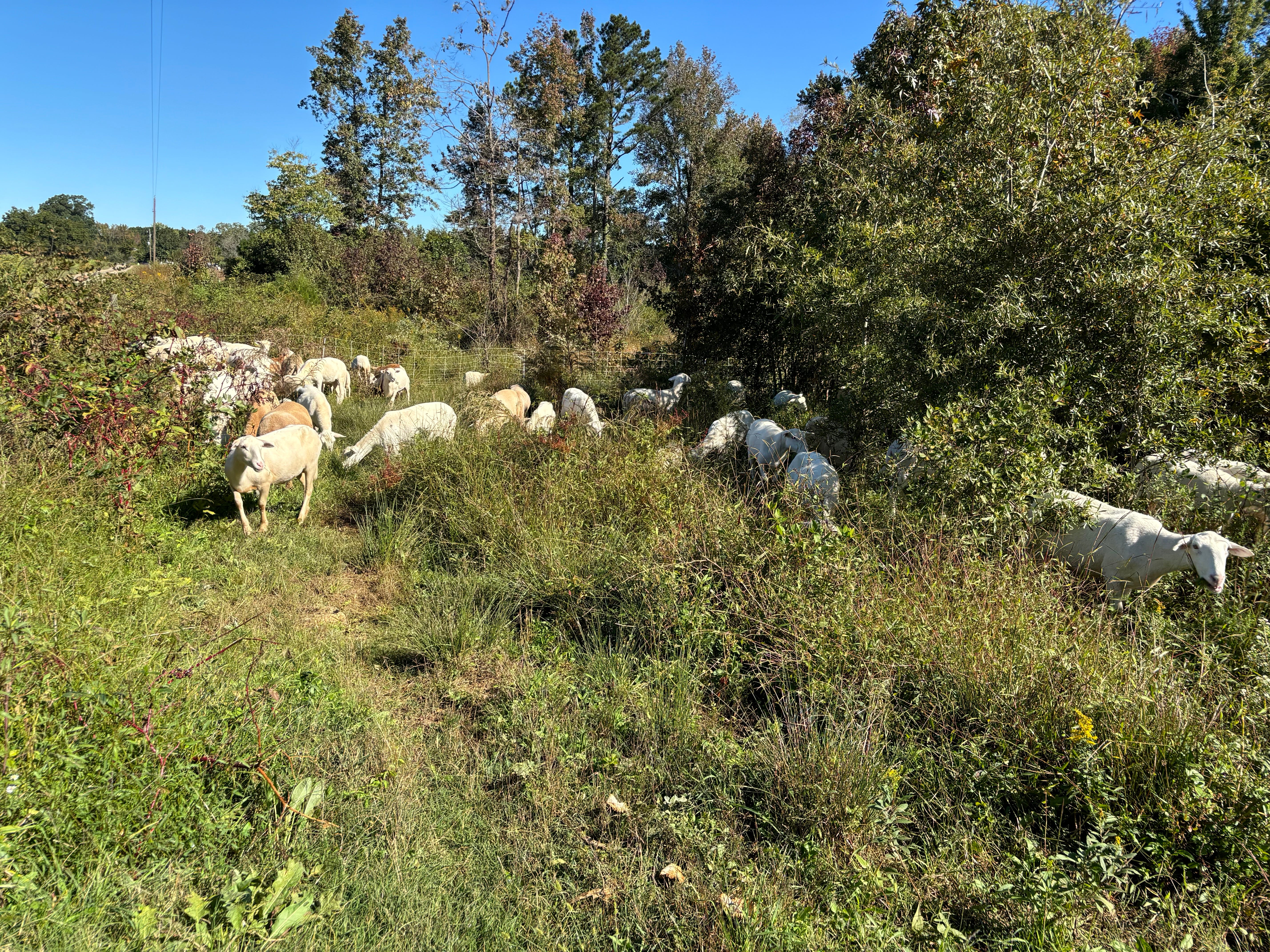
Sheep herd in cutover, September 2024, Bell Farm
In 2020, we decided to cut down a thick belt of yellow pine trees that ran the length of our farm, north to south. The previous owners had planted them primarily as a buffer from the road. Eventually, the trees would grow to maturity, be felled, and bring the owners some money.
When we bought the farm, we consulted with a cluster of foresters and scientists about what to do. At this point, we knew the land wasn’t productive and wouldn’t be, at least not without a lot of work. Intensively planted pines acidify the soil, and so even if you thin them out, very little will grow among them. All of the experts we talked to said that the trees needed to be clear cut. If they had been tended or thinned fifteen years ago, maybe we could have developed a silvopasture system that promoted the long term health of the best-looking trees. But at this late stage, decades later after planting and minimal management, so many of them were in a state of ill-health that the best thing to do would be to cut them all down and start over.
It was a strange experience to stand among those pines. They were planted so tightly together that nothing would grow between them except some odd looking mushrooms I’ve never seen anywhere else. On your way in or out, a few branches might scrape your face or shoulders. But that was it. If you stood still in the middle of them, you might catch the rumble of a tractor, or a dog barking, or the wind whistling in the treetops. But it was mostly a soundless, colorless, lifeless place. A few birds in the canopy, but no creatures scurried across the needles. Not much food there, and nowhere to hide.
For two weeks that summer, we paid a local logging company to cut, chip, and haul those trees away. I remember the extraction of those trees as a flurry of rumbling destruction: tree by tree cut at the base, laid flat by the cutter, and hauled off by the giant forceps of the skidder machine. Logging trucks marched single file on and then off the farm, hour by hour, day by day. Two weeks later, when the loggers were done, the landscape was littered by countless brown stumps, sticks, and trunks, peering up from the blank soil. It took me days to take in the scale of the destruction. All along the gravel path that runs alongside our farm lay the remnants of the pine forest that I knew, for the sake of productivity and the ecological health of the farm, had to go. But even for excellent reasons, the loss of life felt immense. Was I sure–were the “experts” I spoke to sure–that this was the best course?
In the weeks after the loggers left, I pulled the debris I could handle into small piles that I would burn later. Then, with the tractor, I distributed around a hundred round bales of hay (50 to 60 tons) geometrically across the landscape. That fall, I brought a small herd of bred cows into the cutover. When the cows arrived, I began to graze them intensively, deliberately, across the land. For a day or so, they stared and mooed at me, wondering whether I really expected them to spend the winter in a place with no pasture. When they finished the hay in March, much of the cutover was covered in a thin layer of spent hay and manure. In the spring, fifty pigs got to have their turn.
Looking back, I’m not sure that I had much of a coherent plan with the cutover. We could have spent the money we got from the timber sale on digging out the stumps and regrading the terrain. But that would have almost certainly cost more than the sale of the timber itself, and more likely than not, I would be trading one set of problems for another. When you “stump,” or dig up, thousands of tree stumps on land like this, you lose a very large quantity of soil. My neighbor had told me that, sixty years ago, when the farm belonged to a much larger farm called Eden Valley, the portion of my farm planted in pines had the most productive soil in our corner of the county. Since then, the pines surely hadn’t done that land any favors. But it still seemed wrong to inflict further damage on the place when there might be another way of caring for it and bringing it back to life.
This fall, I’ve spent a lot of time in the cutover. Because the autumn has been so warm, I’ve been able to graze it with the sheep herd two more times than I normally would. I wish I could say it looks perfect. Plenty of opportunistic and unwelcome species have popped up: sweetgum, dogfennel, broomstraw, lespedeza, multiflora rose. But right alongside them I find native grasses, forbs, shrubs, and trees: indiangrass, purpletop, ash, persimmon, crabapple, american holly, at least half dozen species of quercus (oak). Three growing seasons have come and gone since the loggers came, and the cutover is probably the most biologically active and interesting places on the farm.
The plan is for this area to become silvopasture, or mixed hardwoods and pasture land. Standing out there, you can feel like it’s close. We’ve identified the saplings we want to keep and what we’ll remove with the chainsaw or the brush cutter. It’ll be a long time before those trees reach maturity. In all likelihood, I’ll be dead before they reach maturity. But that’s fine with me. Maybe, if I’m lucky, someone will thank me when I’m gone.
Lovely piece Jack.
I am struck but the amount of unavoidable ignorance that comes with making ecological decisions on the farm, exemplified by your doubts "were the experts right?" It's like when Wendell Berry built his ill-fated pond documented in his reflection "Damage" - the farmer does what he thinks best, but unintended outcomes and emergent problems are never far behind. Acting, then, in a way that is ecologically and agronomically sound is an act of faith - the outcomes may not be as intended, but the farmer needs to act regardless. But, this necessitates gaining as much wisdom and counsel as possible, for in the words of Stegner "What I really only want to say that we may love a place and still be a danger to it.” - gaining wisdom makes it more likely that our love for the land will have loving outcomes.